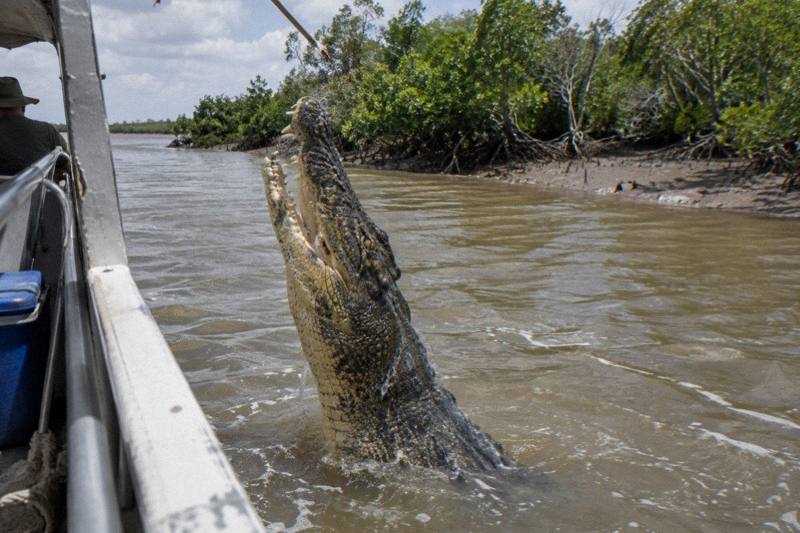
How Close Do The Crocodiles Get To The Boat On The Adelaide River?
No operator or NT Government source publishes a crocodile-to-boat distance for the Adelaide River cruises. Here is what the operators do say about proximity, feeding, boats and safety rules.
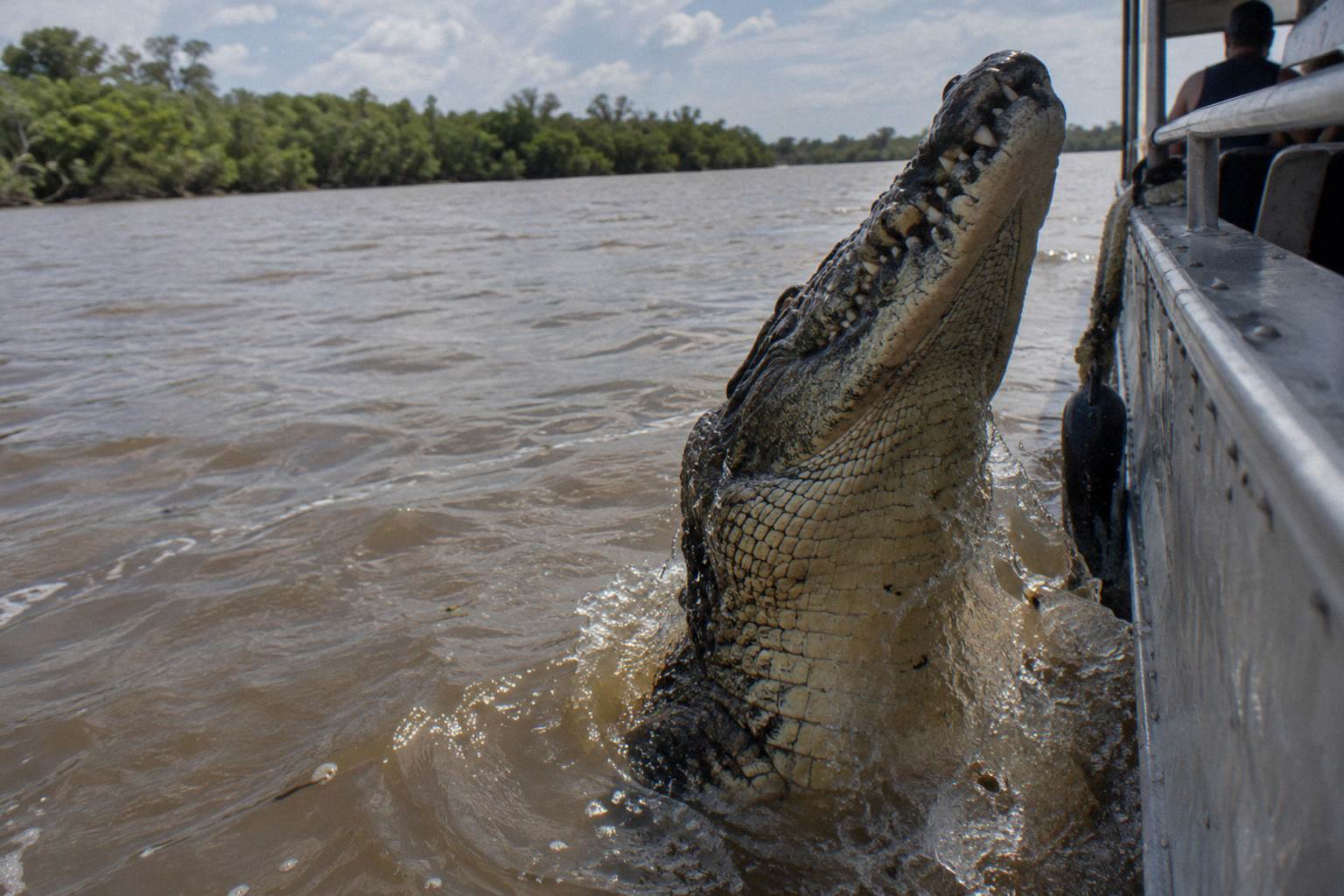
No cruise operator on the Adelaide River and no Northern Territory Government page publishes a distance between the crocodiles and the boats. There is no published metre figure, no jump height, no jump distance and no how-close-to-the-boat number anywhere in the official sources. What the operators do publish is this: the crocodiles are wild, they are offered food from the front of the vessel, and no direct contact is permitted.
That absence of a number is not evasion, it is accuracy. Crocodiles are wild animals, and the Original/Queen operator says it plainly on its own FAQ: "We see crocodiles on almost every tour... behaviour can never be guaranteed." A distance that holds on one cruise at 9am on a June morning can be a very different distance on the same river in February. So this page does what the sources allow. It states once, clearly, that no proximity figure exists, and then it gives you the decision content: what the boats are like, what the operators say happens at the front of the vessel, what rules keep passengers where they should be, and what the NT Government itself says about crocodiles and boats anywhere in the Top End.
The reason people ask this question is usually a mixture of thrill and nerves, and both are reasonable. A saltwater crocodile is the largest living reptile on earth and can grow up to 6 m, according to the NT Government's own wildlife pages. When an animal that size propels itself out of the water next to a pontoon, proximity stops being an abstract number. The experience is the proximity. But it is managed proximity, run under NT wildlife permits, by operators who each publish rules about what passengers may and may not do. Understanding those rules is a better preparation for the cruise than any invented metre count could ever be.
If you are weighing up which departure to book, the three river operators each run the same fundamental experience with different vessels and different prices, and the choice between them is covered later on this page. For a deeper look at the mechanics of the jump itself, read why crocodiles jump out of the water on the cruise, which covers the feeding logic in more detail.
Why Do The Crocodiles Come So Close To The Cruise Boats?
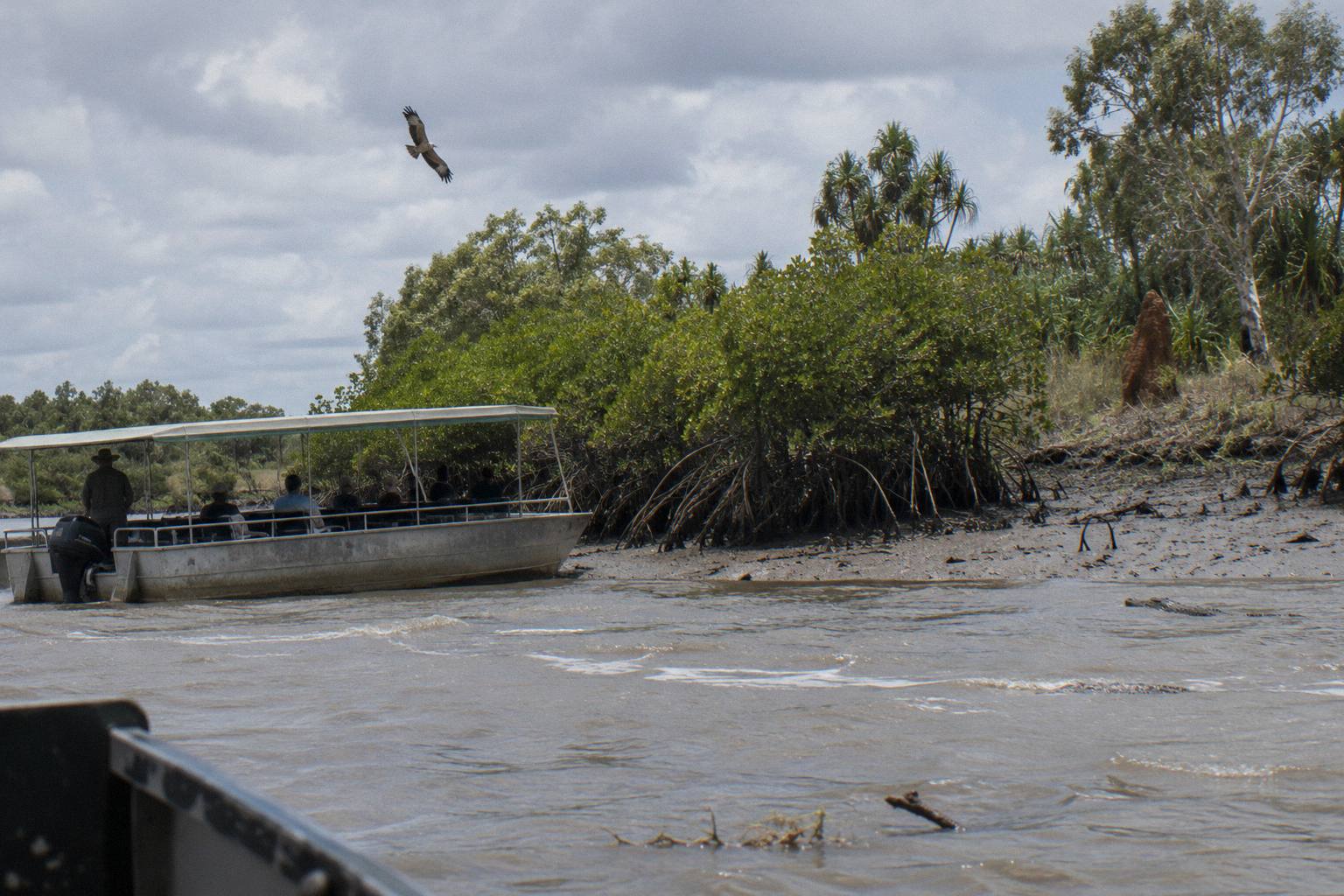
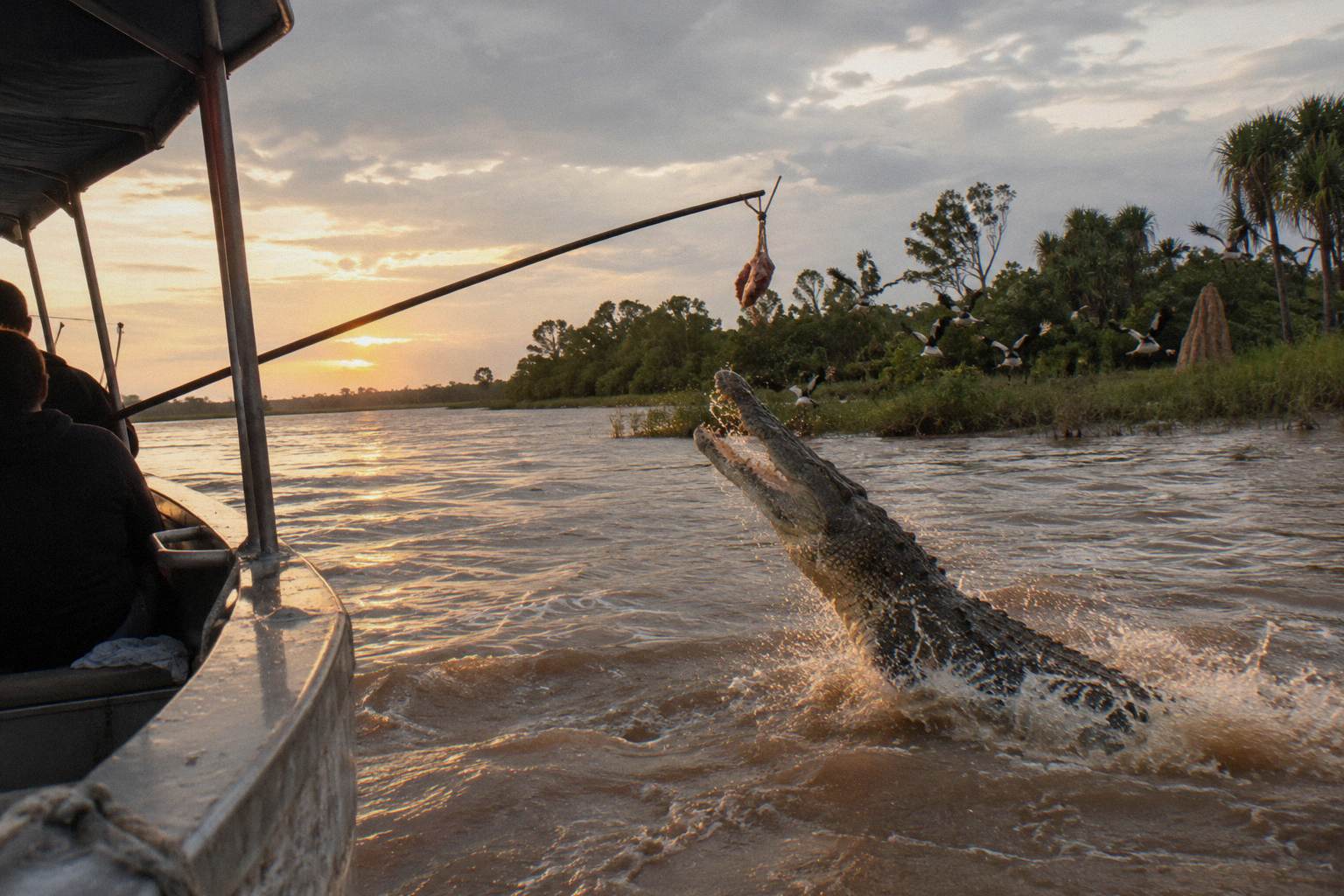
The crocodiles approach the boats because the crews offer them food, and they have done so for long enough that individual animals associate the vessels with a meal. Spectacular says its crocodiles are offered a taste of buffalo meat from a "jumper" position at the front of its boats. The Original/Queen operator says its crocodiles are 100% wild and its feeding is done under NT wildlife permits. Nobody is chasing crocodiles down; the animals come to the boat.
This is the single most important fact for understanding proximity on the Adelaide River. The crocodiles are not accidentally bumping into tour boats. They swim over on their own initiative, because decades of permitted feeding activity have taught the river's large crocodiles that a boat engine means food. The NT Government says nobody may take or interfere with a crocodile without a permit, and the operators state that their feeding operates under those wildlife permits from NT Parks and Wildlife. The NT page does not describe the cruise permit scheme itself, so it is worth being precise about who says what: the permit claims come from the operators, and the legal framework comes from the Government.
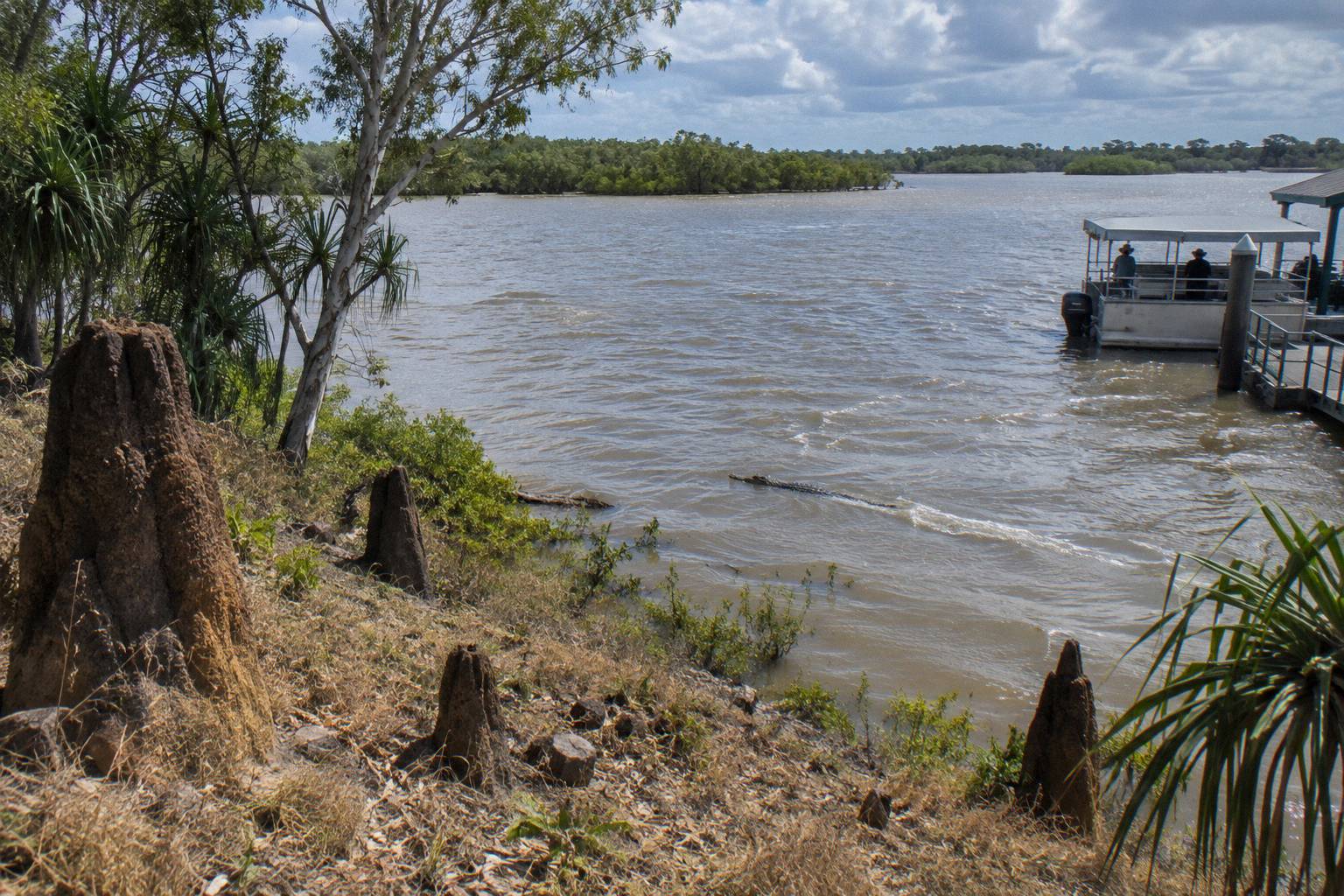
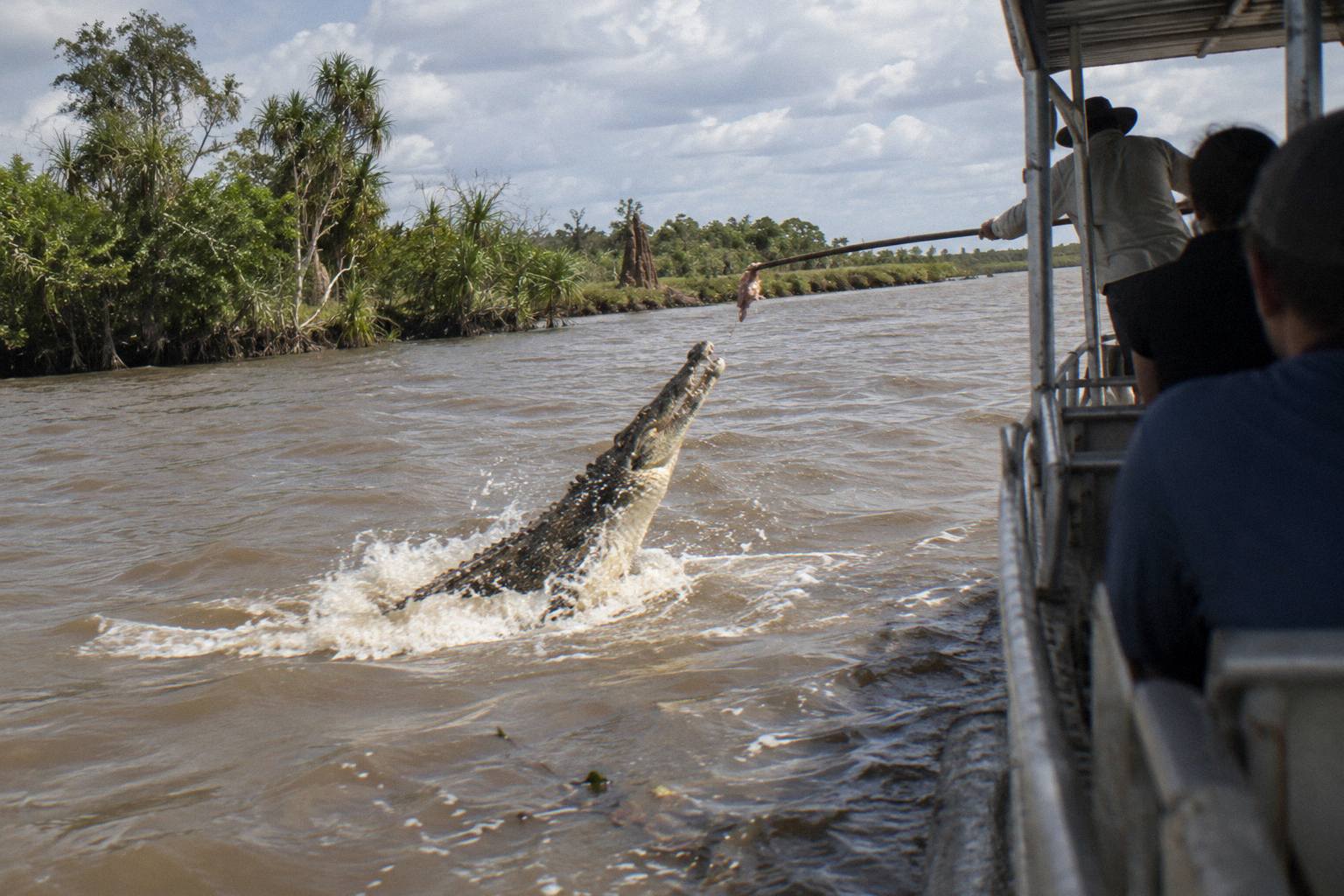
Spectacular's account of its own practice is unusually detailed. It says the crocodiles are offered a taste of buffalo meat, that its staff hold Wildlife Permits from NT Parks and Wildlife, that its Animal Ethics Policy was developed with NT Parks and Wildlife, that there is no direct contact between passengers and crocodiles, and that detailed feeding logs are kept. Its boats have a "jumper" at the front, which is the position from which the food is presented. The crocodile rises toward the food at the front of the vessel, and that is the moment the cruise exists to show you. The proximity between jaw and hull is a function of how the feeding is done, not of luck.
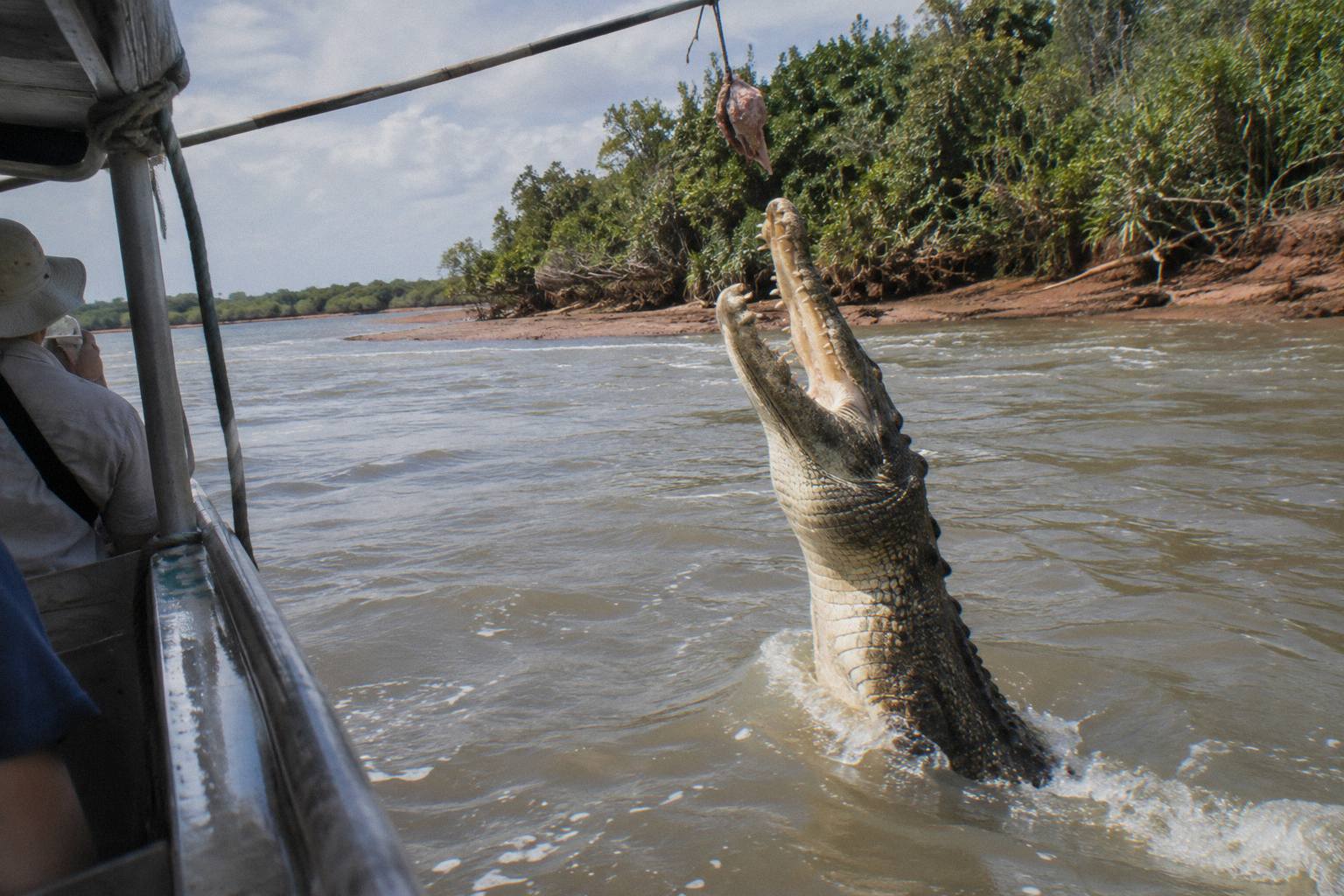
The Original/Queen operator frames the same activity slightly differently but to the same effect: its crocodiles are 100% wild, and the feeding is done under NT wildlife permits. "Wild" and "fed from boats" are not contradictions here. The animals live in the river, hunt for themselves, and treat the cruise boats as one more food opportunity among many. Neither operator, and no NT Government page, publishes a jump height, a jump distance or a how-close-to-the-boat figure, and this page will not invent one. What can be said is structural: the food is presented from the front of the vessel, the crocodile comes up to the food, and the passengers watch from seating behind the action.
Here is what the permitted feeding involves, according to each operator's own published account:
| Operator | What it feeds | Permit and policy basis | Contact with crocodiles |
|---|---|---|---|
| Spectacular Jumping Crocodile Cruises | A taste of buffalo meat, presented from a "jumper" at the front of its boats | Wildlife Permits from NT Parks and Wildlife; Animal Ethics Policy developed with NT Parks and Wildlife | No direct contact, per the operator; detailed feeding logs kept |
| The Original Jumping Crocodile Cruises (Adelaide River Queen) | Feeding under NT wildlife permits, specific food not detailed in the sources | NT wildlife permits, per the operator | Crocodiles described as 100% wild; no contact claim published |
| Adelaide River Cruises | Not detailed in the sources | Not detailed; the cruise opens with a safety briefing from the guides | Not stated |
A reader asking how close the crocodiles get is often really asking whether the feeding is harmful to the animals. The sources deliberately do not editorialise on this, and neither will this page. Never say feeding is, or is not, harmful beyond what the operators and the NT Government state. What the sources do establish is that the activity is permitted, logged in Spectacular's case, and conducted with explicit no-contact rules for passengers. If you want the full background on the behaviour itself, why crocodiles jump out of the water on the cruise goes into the mechanics.
What Are The Boats Like, And Where Do You Sit?
Three operators run the cruises from three separate jetties, and their vessels differ in ways that shape how you experience the close moments. Spectacular runs the undercover multi-hull Croc-Cat1 with stadium-style seating and the smaller Wildcat. The Adelaide River Queen has an air-conditioned lower deck and an open-air upper deck behind croc-proof glass, per the operator. Adelaide River Cruises does not state its boat type.
The vessel matters to this question more than almost anything else, because the boat is the barrier. On Spectacular's boats, the skipper sits at the rear of Croc-Cat1 and the feeding happens at the front, where the "jumper" position is. The seating is stadium-style, which in practice means tiered rows rather than a flat deck, under cover. Which of the two vessels runs depends on the numbers booked on the day, and Wildcat, being smaller, goes further down the river. Boat capacity is not stated by the operator, so it cannot be repeated here, and no capacity figure should be treated as applying across the site.
The Adelaide River Queen is the most structurally distinct option. The operator describes a lower deck that is air-conditioned and an open-air upper deck with a shaded canopy, individual seating, and croc-proof glass. That glass is the operator's own description, and it is the clearest published statement of a physical barrier between passengers and animals on any of the three fleets. For a nervous passenger, or anyone travelling with small children who wants a defined boundary, that is decision-relevant information, and it is the reason to read what to expect on a jumping crocodile cruise before booking rather than after.
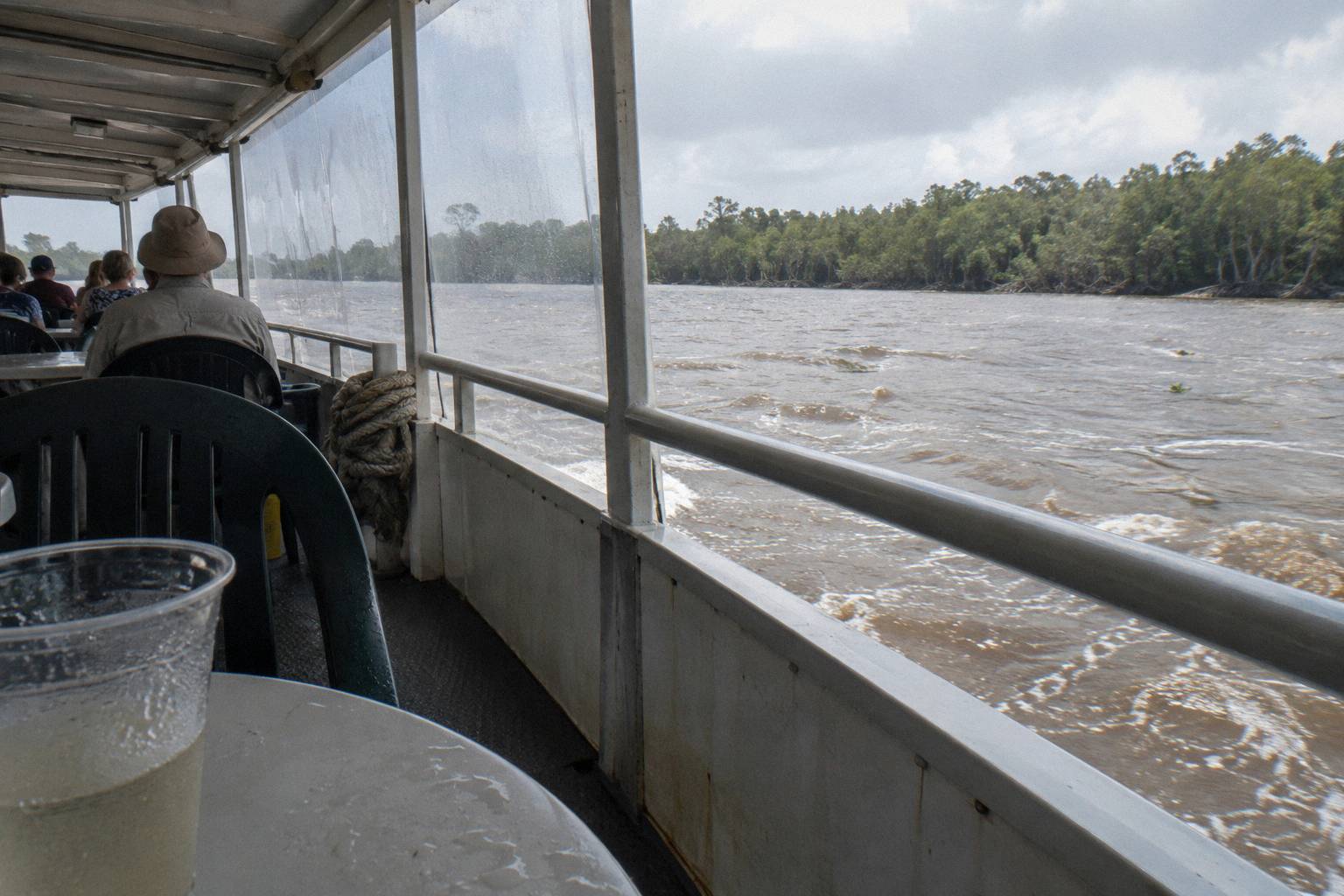
The same operator also runs the Pathfinder vessels: open-air boats carrying up to 38 passengers each, a figure stated for the Pathfinder only and never to be presented as site-wide. Being open-air, the Pathfinder is the format with the least between you and the river air, which cuts both ways depending on whether you read that as immersion or exposure. The third operator, Adelaide River Cruises, states no boat type and no capacity; its own pages give two different capacity numbers, so this site prints none. What that operator does publish is a one-hour experience that opens with a safety briefing from the guides on crocodile behaviour and the rules, which is the briefing most directly aimed at the question in this article's title.
| Operator and vessel | Deck and cover | Barrier, per the operator | Capacity |
|---|---|---|---|
| Spectacular: Croc-Cat1 (multi-hull) | Undercover, stadium-style seating, skipper at the rear | No published barrier; feeding from a "jumper" at the front | Not stated |
| Spectacular: Wildcat | Undercover, smaller, goes further down the river | No published barrier | Not stated |
| Adelaide River Queen | Air-conditioned lower deck; open-air upper deck with shaded canopy | Croc-proof glass, individual seating, per the operator | Not stated |
| Pathfinder vessels | Open-air | None stated beyond vessel design | Up to 38 passengers, stated for the Pathfinder only |
| Adelaide River Cruises | Not stated | Not stated; safety briefing opens the tour | Not stated, print none |
One point of discipline for your research as you compare options: never accept a "best side of the boat" claim from anywhere. The sources contain no seat advantage of any kind, and the feeding position at the front of the vessel is the only structural fact about where the action happens. The question of which side of the boat is best on a jumping crocodile cruise is examined separately, and the short version is that no source supports a side.
Do The Crocodiles Ever Touch The Boat?
The sources never describe a crocodile making contact with a vessel, and they never describe the boats being struck, bumped or boarded. Spectacular states there is no direct contact between people and crocodiles on its cruises. What the sources do describe is the crocodile rising toward food presented from the front of the boat, close enough for the cruise's purpose, under rules that keep passengers seated and inside the vessel.
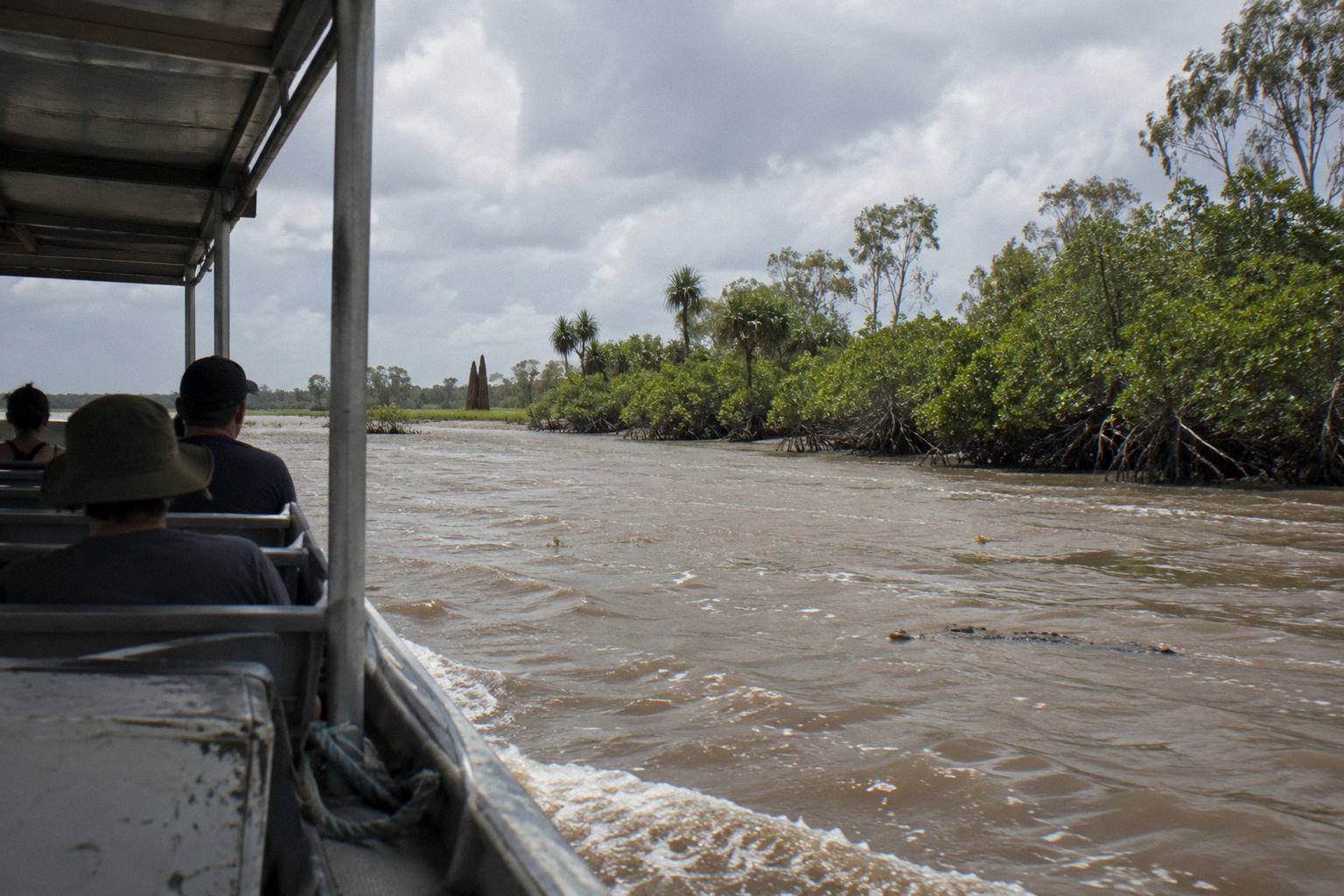
That is the honest ceiling of what can be written. Beyond it, everything is rumour, and the Adelaide River has accumulated decades of rumour. What is verifiable is the rule structure. The Original/Queen operator's published rules include life jackets on board, no swimming, no food on the boat, and supervised children. Adelaide River Cruises opens with a safety briefing from its guides covering crocodile behaviour and the rules. Spectacular states no direct contact with the crocodiles. Each of these exists precisely because wild animals at close range are unpredictable, which is also why the operators are careful never to promise behaviour.
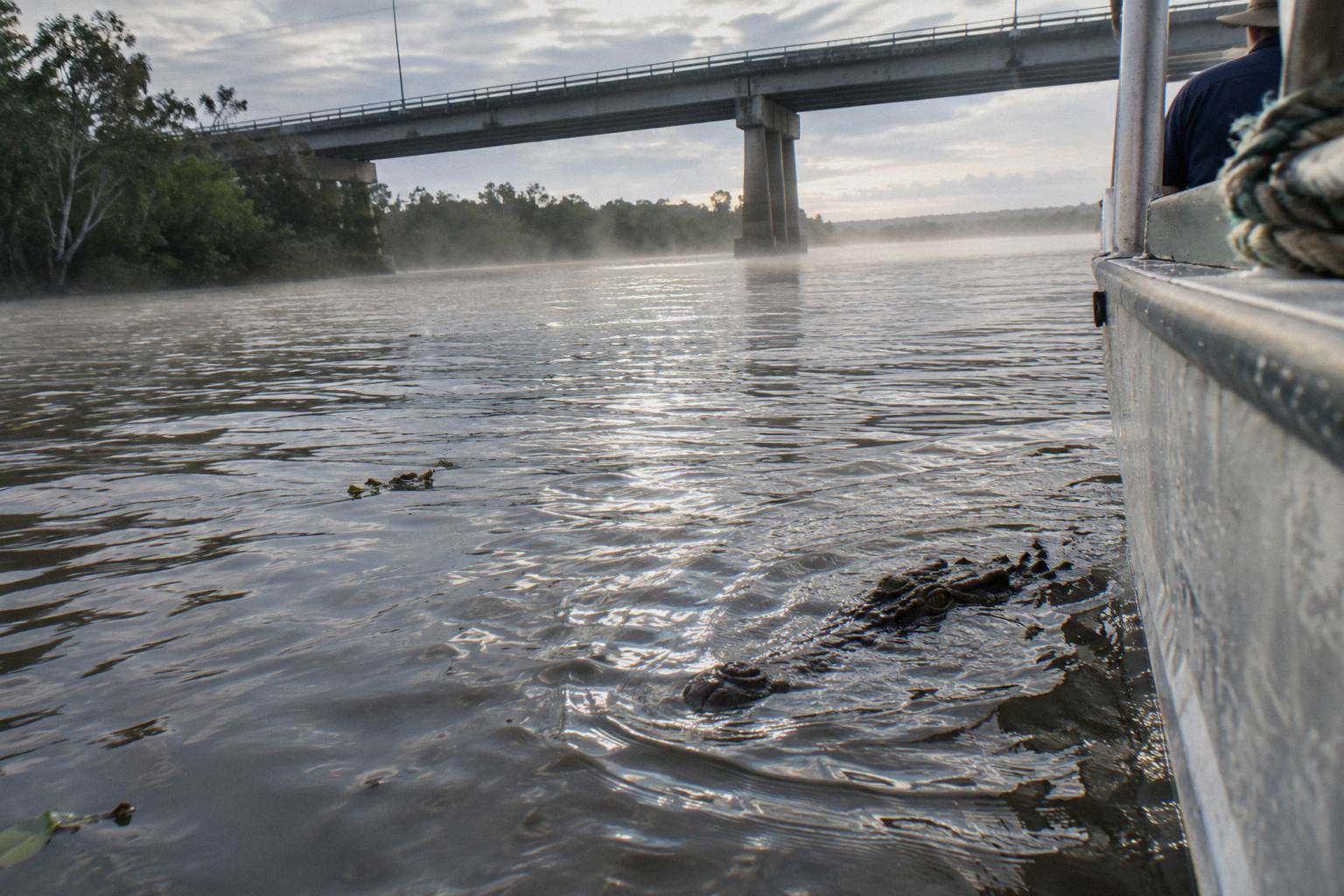
The NT Government's own crocodile safety advice fills in the wider frame, and it applies to any vessel on any Top End water, not only to tour boats. The NT Government's crocodile safety page says any body of water in the Top End may contain large and potentially dangerous crocodiles, and its Be Crocwise advice includes a rule directly relevant to life on a boat: do not lean out of or dangle limbs over the side. The same advice says to camp at least 50 m from the water and to stand at least 5 m back from the water's edge when fishing. On the cruise boats, the operator rules take over from the general advice, and they are stricter because the context is different: the boat is where you are meant to be, seated, with nothing over the side.
Whether the whole arrangement is sound is a fair question, and it deserves a straight answer rather than reassurance. The operators publish their rules and permit basis, the NT Government publishes the legal framework and the safety advice, and nobody publishes a guarantee. The page on whether jumping crocodile cruises are safe works through that question in full, and the essential method is the same as this page's: attribute every safety claim to the operator or the Government that made it, and never write that a cruise is, or is not, "safe" as a flat guarantee.
What Safety Rules Apply On Board?
The published rules are consistent across operators: stay inside the vessel, nothing over the side, no swimming, no food on the boat, children supervised, life jackets on board at the Original/Queen operator, and a safety briefing at the start with Adelaide River Cruises. The NT Government adds its standing advice for all Top End waters: never assume water is safe, and do not lean out of or dangle limbs over the side of a boat.
Each rule earns its place. The no-food rule exists because food on a boat around a feeding crocodile changes what the animal is interested in. The supervised-children rule exists because a child leaning over a rail is the exact scenario the NT Government's advice targets. The life jackets on board at the Original/Queen operator are a standard precaution that also signals the operator's own reading of the environment. Adelaide River Cruises' safety briefing is the most explicit teaching moment of the three: guides cover crocodile behaviour and the rules before the boat leaves, which means every passenger hears the same instructions about conduct near the animals. More of these guides are collected on Adelaide River Crocodile Cruise.
For the reader comparing operators, the differences in rule presentation are worth noticing rather than glossing over.
| Operator | Stated on-board rules | Briefing | Stated barrier or contact policy |
|---|---|---|---|
| Spectacular Jumping Crocodile Cruises | Photography encouraged; undercover vessels | Not detailed in the sources | No direct contact with the crocodiles, per the operator |
| The Original Jumping Crocodile Cruises (Adelaide River Queen) | Life jackets on board, no swimming, no food on the boat, supervised children; smoking and vaping not allowed | Not detailed in the sources | Not stated beyond rules |
| Adelaide River Cruises | Not itemised in the sources | Safety briefing from guides on crocodile behaviour and the rules opens the tour | Not stated |
The Spectacular operator also states that its feeding operates with detailed logs and an Animal Ethics Policy developed with NT Parks and Wildlife, on its cruises page alongside its Wildlife Permits. These are feeding governance facts rather than passenger rules, but they belong in the same picture: the proximity you experience on the water sits inside a documented, permitted practice, not an improvised one. The NT Government's protection page adds the background law: both crocodile species are protected, and you cannot take or interfere with a crocodile without a permit.
So How Close Is Close, Really?
Close enough that a standard phone camera suits the crocodile interactions, in the Adelaide River Cruises operator's own words, because of the proximity; while a zoom lens is useful for wildlife across the floodplain. Beyond that framing, no number exists in any official source, and any metre figure you read elsewhere about the Adelaide River cruises is invention. The crocodiles rise to food at the front of the vessel, and you watch from the seating behind it.
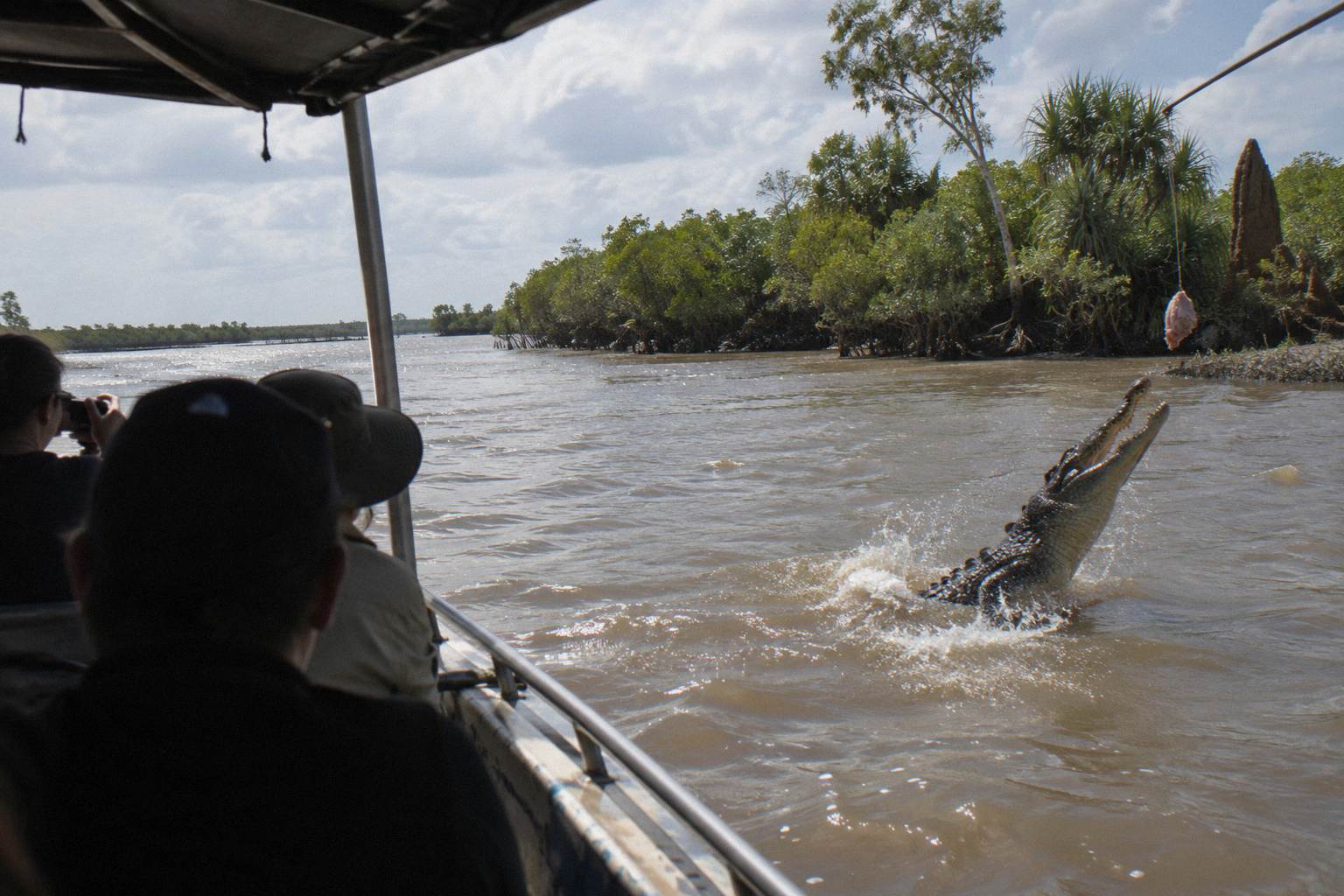
That camera detail is one of the most useful proximity facts the sources contain, precisely because it is incidental. An operator advising passengers that a standard phone camera suits the interactions, because of the proximity, is an operator telling you the animals are near enough to fill a phone frame without optical help. At the same time, the same FAQ suggests a zoom lens for wildlife across the floodplain, which tells you the wider river experience is a looking-at-distance experience, with the crocodile moments as the concentrated exception. Photographers planning around this should read the site's guide to photographing jumping crocodiles, which builds on exactly that distinction.
It helps to fix the animal in your mind with the NT Government's numbers, because they explain why nobody responsible publishes a casual distance. The saltwater crocodile is the largest living reptile and can grow up to 6 m. Large crocodiles can stay underwater for up to an hour with a heart rate of 2 to 3 beats a minute, and for short bursts they can move faster than humans on land. An animal with those capabilities, approaching a boat because it has learned to, is not something any serious operator would caption with a tidy metre figure. The Original/Queen operator's FAQ carries its own version of the same caution: "We see crocodiles on almost every tour... behaviour can never be guaranteed."
The practical takeaway is not to brace for a specific distance but to arrive with the right expectations. You will see crocodiles rise out of the water at the front of the boat, close enough that the moment is the reason the cruise exists. You will not touch one, feed one, or get a published number for the gap, and any review or listing that promises a specific proximity is writing fiction. What you can do is choose the vessel whose barrier and format suit your comfort: undercover stadium seating with Spectacular, the Adelaide River Queen's croc-proof glass, the Pathfinder's open air, or Adelaide River Cruises' briefing-first one-hour experience.
Which Cruise Should You Book For The Closest Experience?
All three river operators run the same one-hour format built around food presented at the front of the vessel, so the choice comes down to vessel, price and structure rather than proximity. Spectacular is A$55 adult, the Adelaide River Queen is A$65 adult behind croc-proof glass, and Adelaide River Cruises is A$58.50 adult with a safety briefing to open. Day tours from Darwin bundle a cruise with transport but print no price here.
Prices are the operators' own and can change; day-tour prices sit on the booking pages and are never comparable with cruise-only fares. If you are driving yourself and want the briefing-led format, the Adelaide River Cruises one-hour experience departs from Anzac Parade, Middle Point, about an hour or a little more from Darwin, with departures listed at 9am, 11am, 1pm and 3pm. Arrive at least 15 minutes early. Book ahead: the operator says tours sell out and walk-ins are not guaranteed.
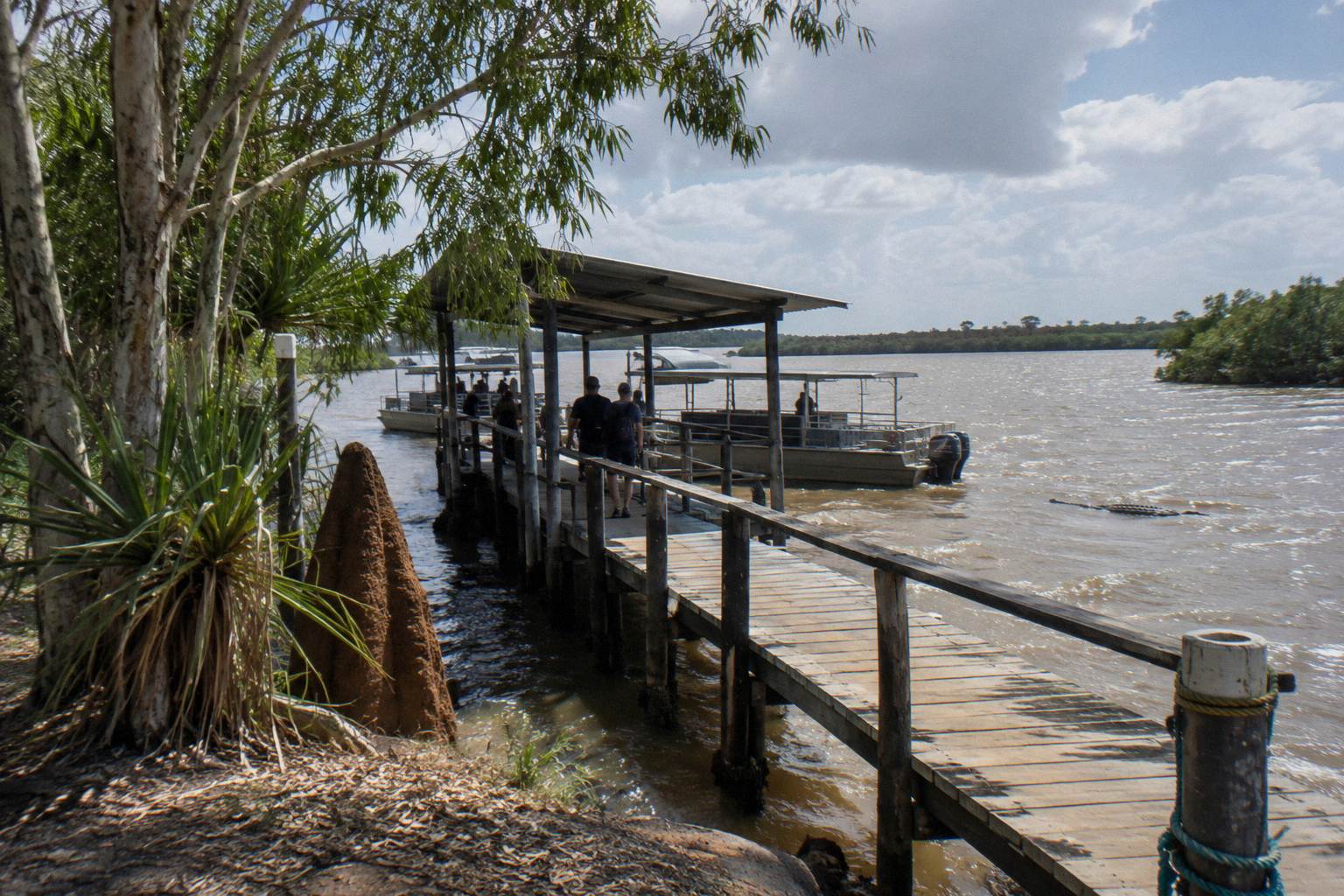
If the undercover stadium format appeals, the Spectacular Jumping Crocodile Cruise runs from Beatrice Hill Farm on the Arnhem Highway, just under an hour from Darwin, with free parking and the same 9am, 11am, 1pm and 3pm daily departures at A$55 adult and A$40 child, infants 3 and under free, excluding a small booking fee added at checkout. The operator says its cruises do sell out. Its jetty is reached past the Windows on the Wetlands Visitor Centre and about 2 km of well-maintained unsealed access road that the operator says is fine for hire cars, and the access road often shows water buffalo, cattle and wading birds, which is a fitting warm-up.
For travellers without a car, the question becomes which bundle to take from Darwin, and the options range from about 4 hours to a full day, adding Fogg Dam, Windows on the Wetlands, Humpty Doo, or Litchfield National Park around the cruise. No day-tour price, start time or pickup point is stated on this site, so check the booking page for each. The deciding factors are duration, inclusions and who is driving, not how close the crocodiles get, because the cruise component is the same river and the same animals whichever bus you arrive on.
Common Questions About How Close The Crocodiles Get
Common Questions About Crocodile Proximity On The Adelaide River
How Close Do The Crocodiles Get To The Boat On The Adelaide River?
No operator and no NT Government page publishes a distance, a jump height or a jump measurement for the Adelaide River cruises. The crocodiles rise toward food offered from the front of the vessel, and passengers watch from the seating behind. Spectacular states there is no direct contact with the crocodiles, and Adelaide River Cruises opens with a safety briefing.
Do The Crocodiles Touch The Cruise Boats?
The sources never describe a crocodile making contact with a vessel. The operators describe the animals rising to food presented from the front of the boat under NT wildlife permits. Spectacular says there is no direct contact between people and crocodiles on its cruises.
Is There A Fence Or Glass Between You And The Crocodiles?
Only on the Adelaide River Queen, which the operator describes as having croc-proof glass and individual seating. Spectacular's vessels are undercover with stadium-style or open seating, the Pathfinders are open-air, and Adelaide River Cruises states no barrier, only a safety briefing at the start.
How High Can The Crocodiles Jump?
No operator and no NT Government page publishes a jump height or jump distance. Any specific figure you read elsewhere is not sourced from the operators or the Government. What the NT Government does publish is that the saltwater crocodile can grow up to 6 m.
Are The Crocodiles Wild Or Captive?
The Original/Queen operator states its crocodiles are 100% wild and that feeding is done under NT wildlife permits. Spectacular says the crocodiles are offered a taste of buffalo meat under Wildlife Permits from NT Parks and Wildlife, with detailed feeding logs kept.
What Stops A Crocodile Getting Onto The Boat?
No source describes a crocodile boarding a vessel. The controls that are published are the NT Government's Be Crocwise advice, including never leaning out or dangling limbs over the side, and the operators' rules: no swimming, no food on the boat, supervised children, life jackets on board at the Original/Queen operator, and a safety briefing with Adelaide River Cruises.