What Wildlife Can You See On The Adelaide River Besides Crocodiles?
The Adelaide River's other wildlife: sea eagles, kites, bull sharks, sawfish, buffalo and wading birds, drawn from what the cruise operators and the NT Government actually publish.
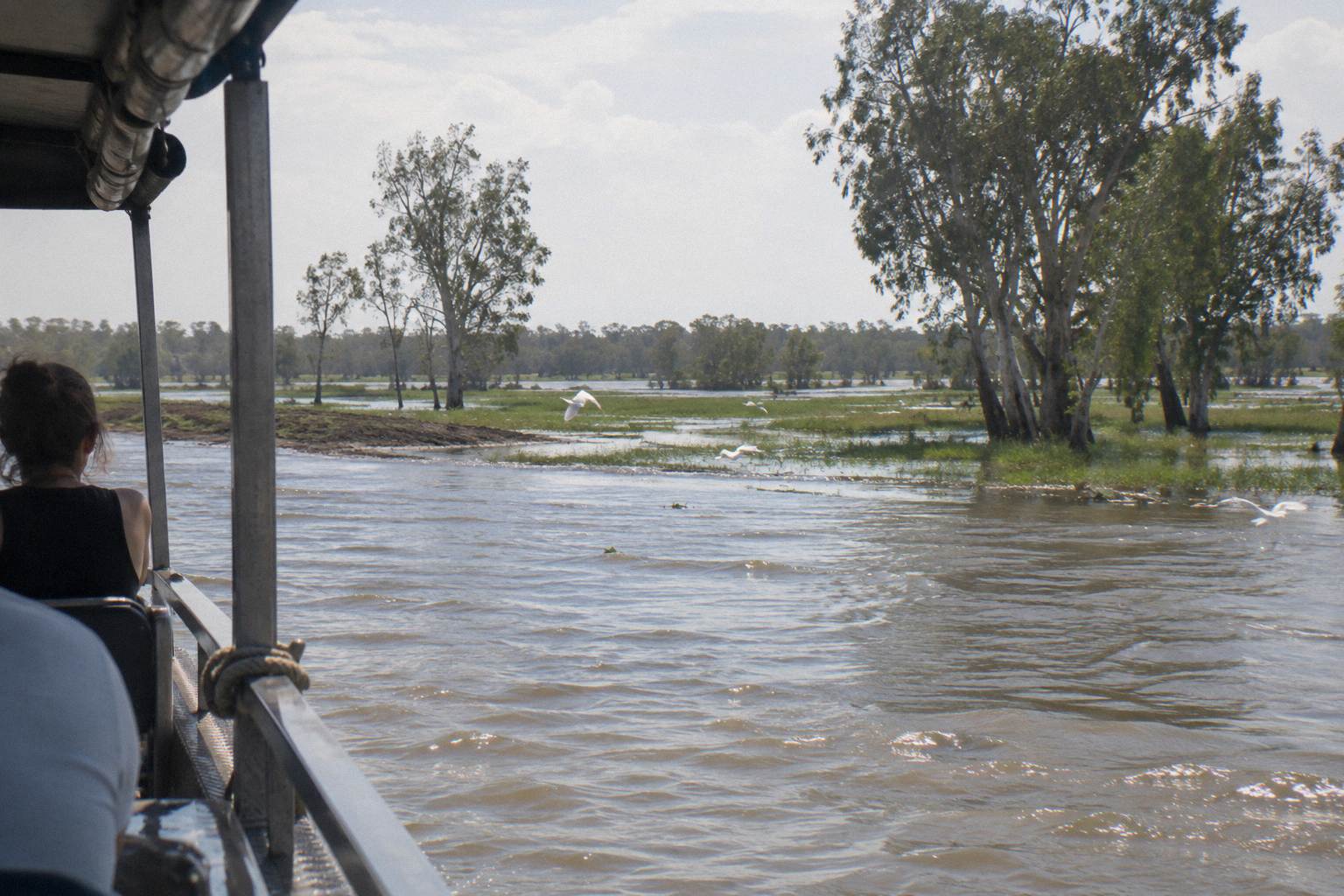
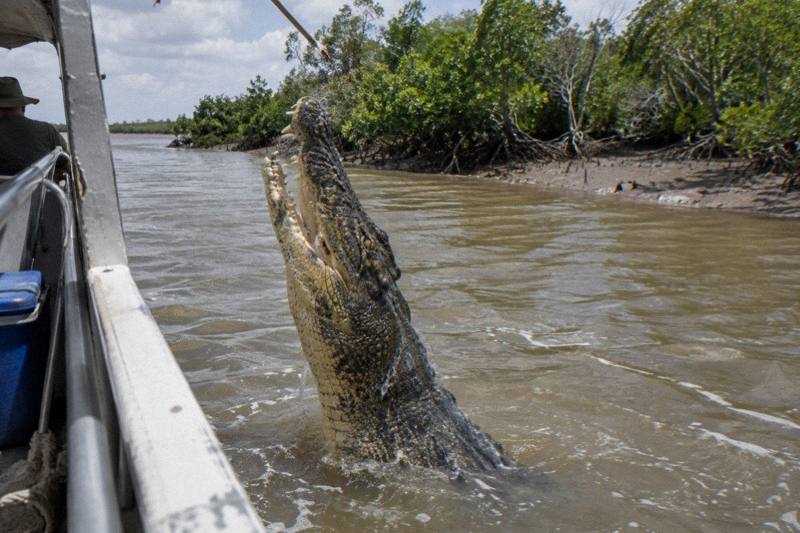
Saltwater crocodiles are the headline act on the Adelaide River, and honestly they earn the billing. The NT Government counts them as the largest living reptile, capable of growing up to 6 m, and the jumping-cruise crocodiles are exactly that species. But a one-hour cruise across a Top End floodplain passes through a wider ecosystem than one predator, and a lot of it is easier to watch than the crocs. Birds circle overhead, the water holds species most visitors have never heard of, and the drive in can feel like a safari of its own.
There is a catch that an honest wildlife page has to state up front: the only cruise operator that publishes a species list is Spectacular Jumping Crocodile Cruises, and even that is the operator's own wording, not a survey. The other two river operators, Adelaide River Queen Cruises and Adelaide River Cruises, state no wildlife list at all on the pages this site draws from. So this page works from what is actually published: one operator's list, one operator's notes on its access road, and the NT Government's species facts. Nobody, operator or government, publishes sighting odds, and no honest page should promise an animal.
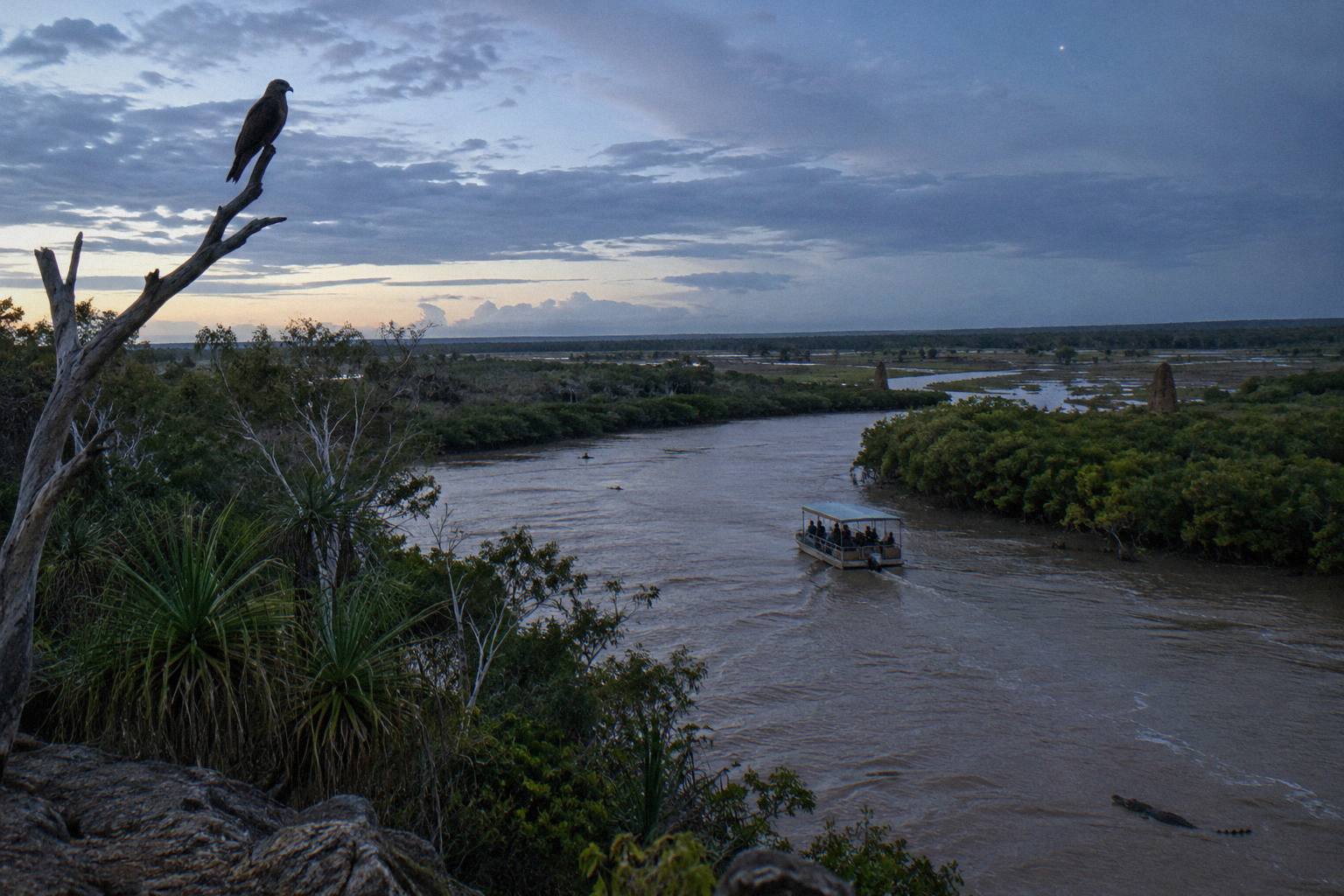
The published answer comes from one operator's list: Spectacular Jumping Crocodile Cruises names white-bellied sea eagles, whistling kites, freshwater crocodiles, bull sharks, black flying-fox, the endangered speartooth shark and the critically endangered largetooth sawfish as river wildlife. The same operator says its access road often shows water buffalo, cattle and wading birds. The other two operators publish no wildlife list at all.
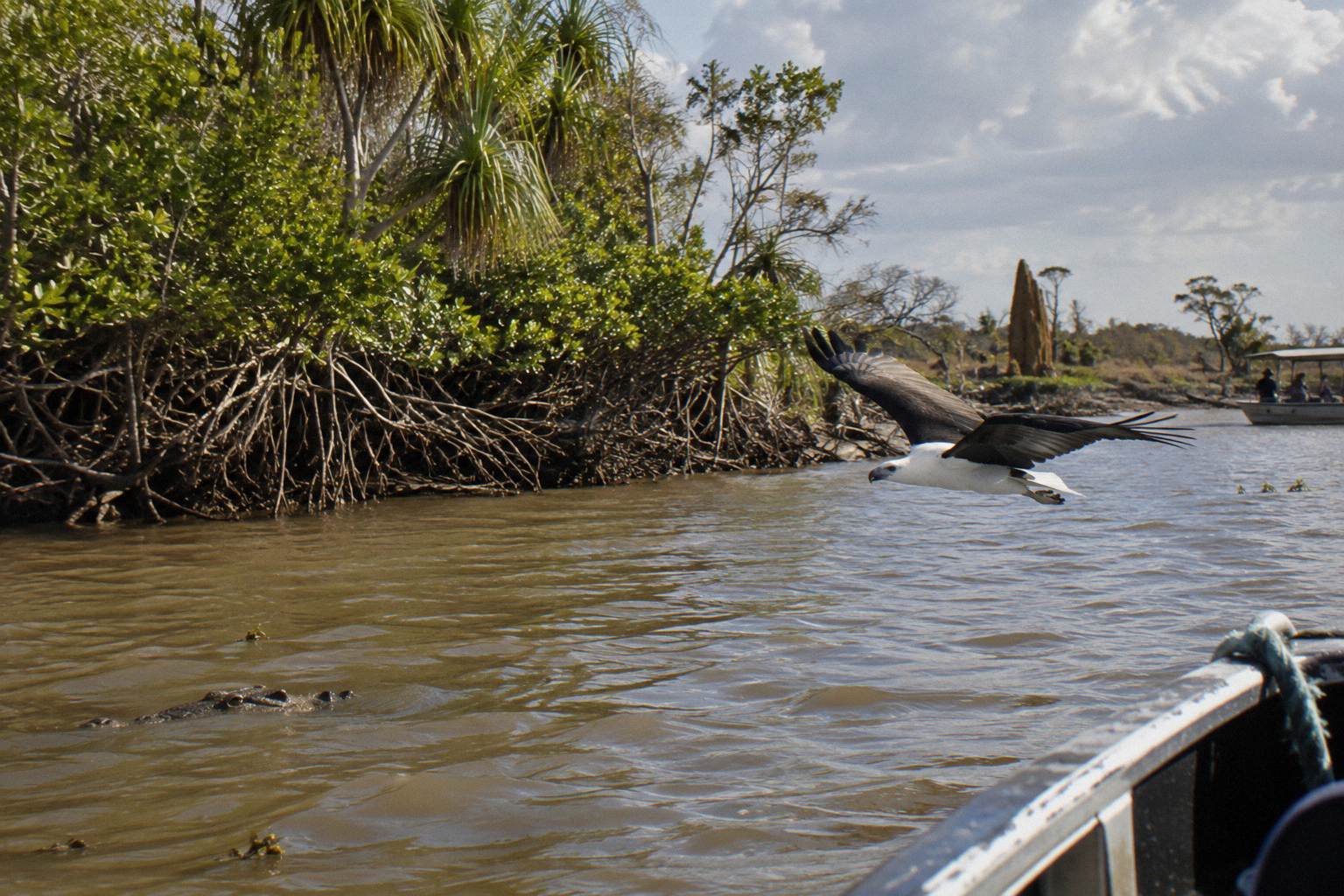
That list is worth slowing down over, because several entries surprise people. Bull sharks in a river hundreds of kilometres of wetland away from the ocean are a genuine Top End phenomenon, and the speartooth shark and largetooth sawfish are serious conservation stories in their own right. The birds of prey are the most reliable watch: a white-bellied sea eagle holding station over the water is one of the images people remember from the river almost as much as the crocodiles themselves. Freshwater crocodiles, the NT's other crocodile species, also appear on the list, which catches some visitors off guard until they learn the territory holds two distinct species, not one.
What the list does not do is rank anything. There are no bird counts in the sources, no seasonal bird claims, no jabiru entry and no mangrove detail, and this page will not invent any of that. The sources also contain nothing about which cruise departure time sees more wildlife, and the operators themselves publish no morning-versus-afternoon behaviour claims at all. Anyone who tells you the 9am cruise is better for eagles is making it up.
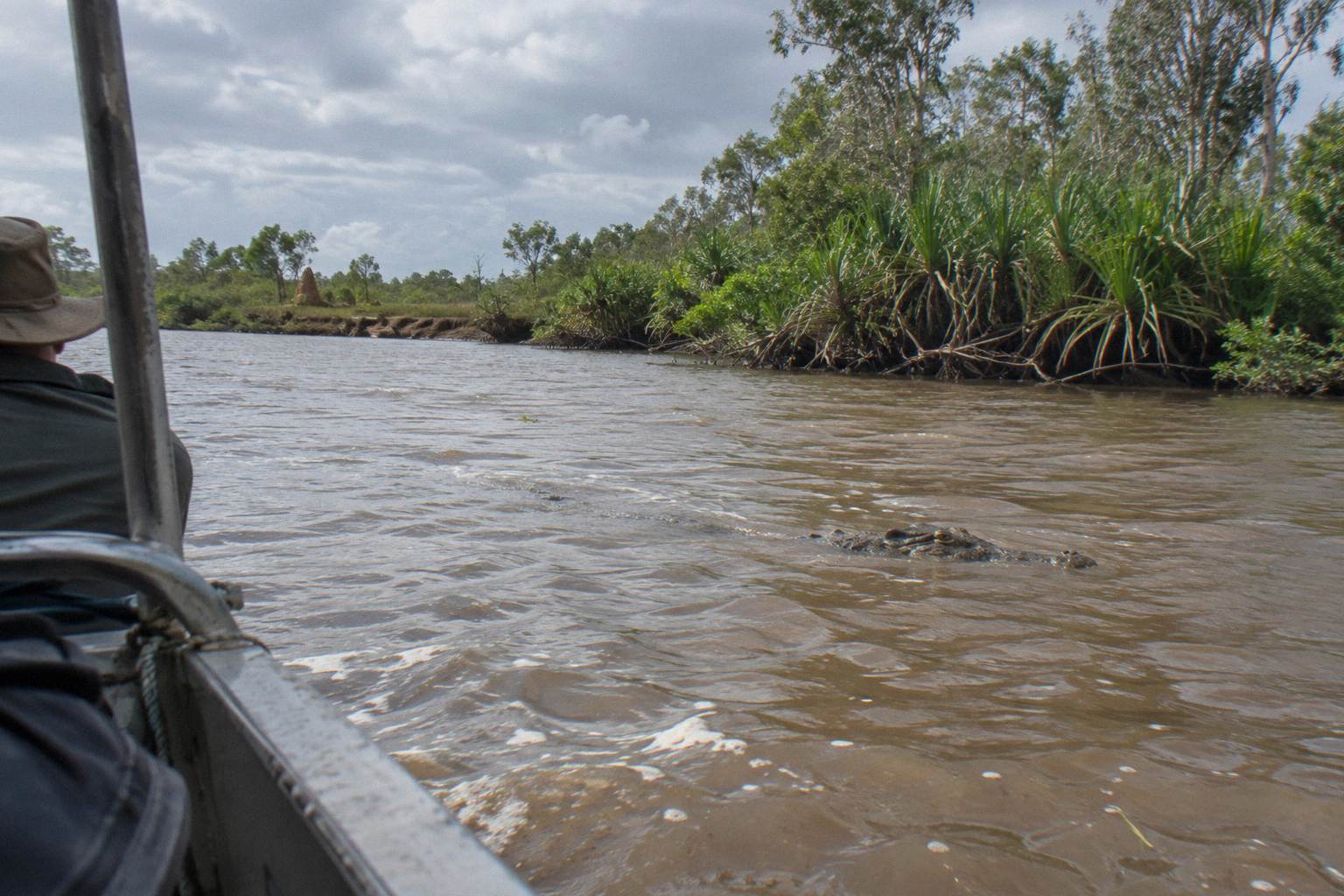
If reading the river's wider cast has sold you on the trip, these are the three ways to get onto the water or out along the wetlands corridor:
- Jumping Croc Experience, 1 Hour
- Spectacular Cruises, 1 Hour
- Queen Original, 1 Hour
- Pathfinder Boat, 1 Hour
- Croc Bus From Darwin
- Cruise With Pub Lunch, Pickup
- Cruise Plus Fogg Dam, 5 Hours
- AAT Kings Half-Day Cruise
- Shuttle Bus Included, 4 Hours
- Scenic Trip With Pickup
- Cruise And Barramundi Fishing
- Litchfield Full-Day Combo
The Adelaide River Cruises Jumping Crocodile Experience, which this site features throughout its river-cruise pages, is the natural pick for a wildlife-minded visitor: the operator explicitly frames a camera or a charged phone as part of the kit, and its own wording says a zoom lens is useful for wildlife across the floodplain while standard phone cameras suit the crocodile interactions because of the proximity. The Pathfinder cruise runs on open-air vessels, which is the only cover-or-weather contrast the sources state between operators, and the day tours add Fogg Dam to the cruise for a longer wildlife day.
Which Birds Of Prey Hunt Along The Adelaide River?
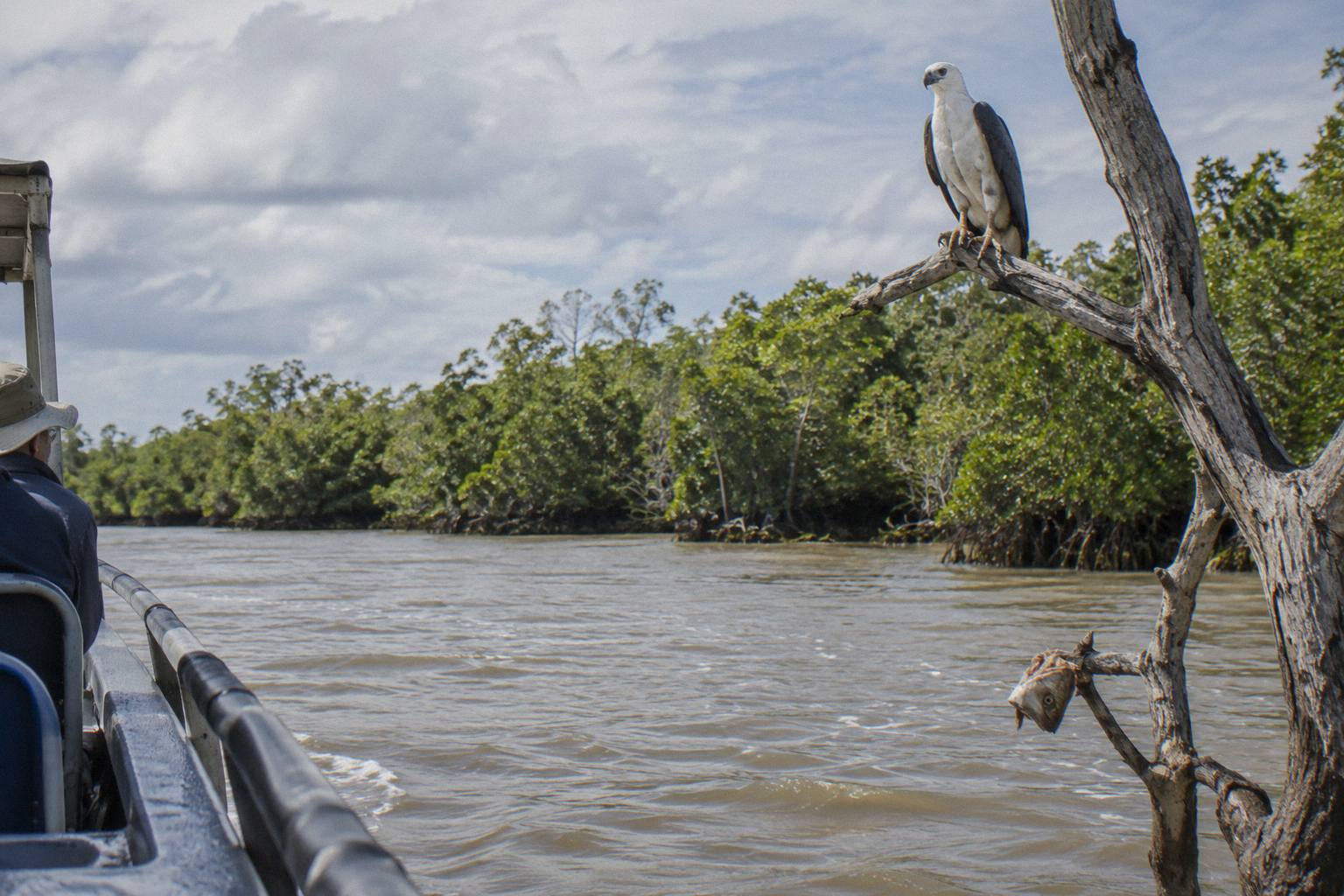
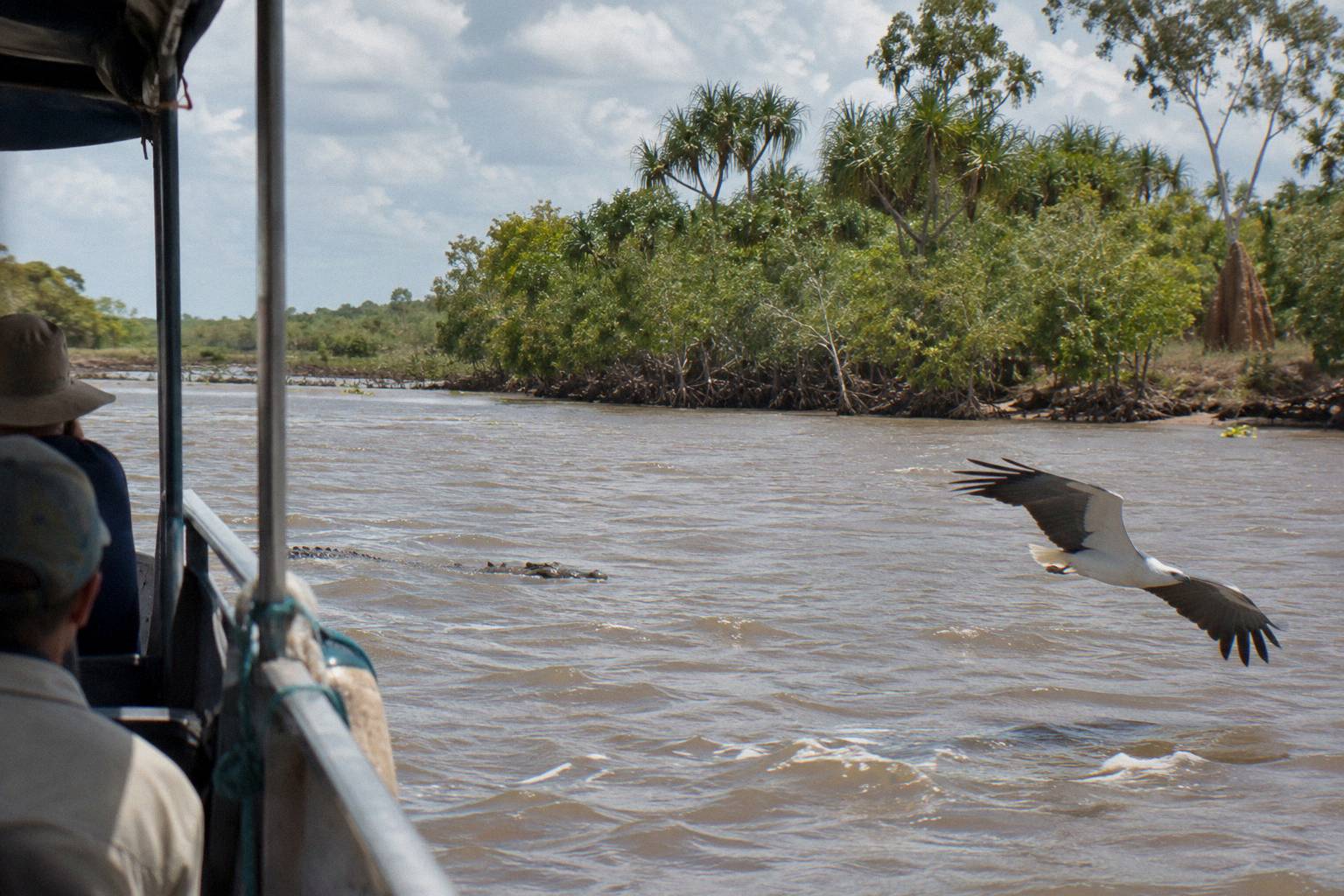
Two raptors appear by name on the operator's list: the white-bellied sea eagle and the whistling kite. Both are published by Spectacular Jumping Crocodile Cruises as part of the river's wildlife, in the operator's own wording. No bird counts, seasonal patterns or additional species are stated in any source this site uses.
The white-bellied sea eagle is the one that stops conversation. It is a large fish-hunting raptor, and over a floodplain it does the thing people hope to see: slow, heavy circuits above the water, eyes down. The whistling kite is the more casual companion of the two, named for its call, and often noted hanging around waterways where something is eating. On a river where crocodiles are being fed, that is not a coincidence, though no operator states anything about why the birds are present, and this page won't either. The sources say nothing about the kites' behaviour beyond the name on the list.
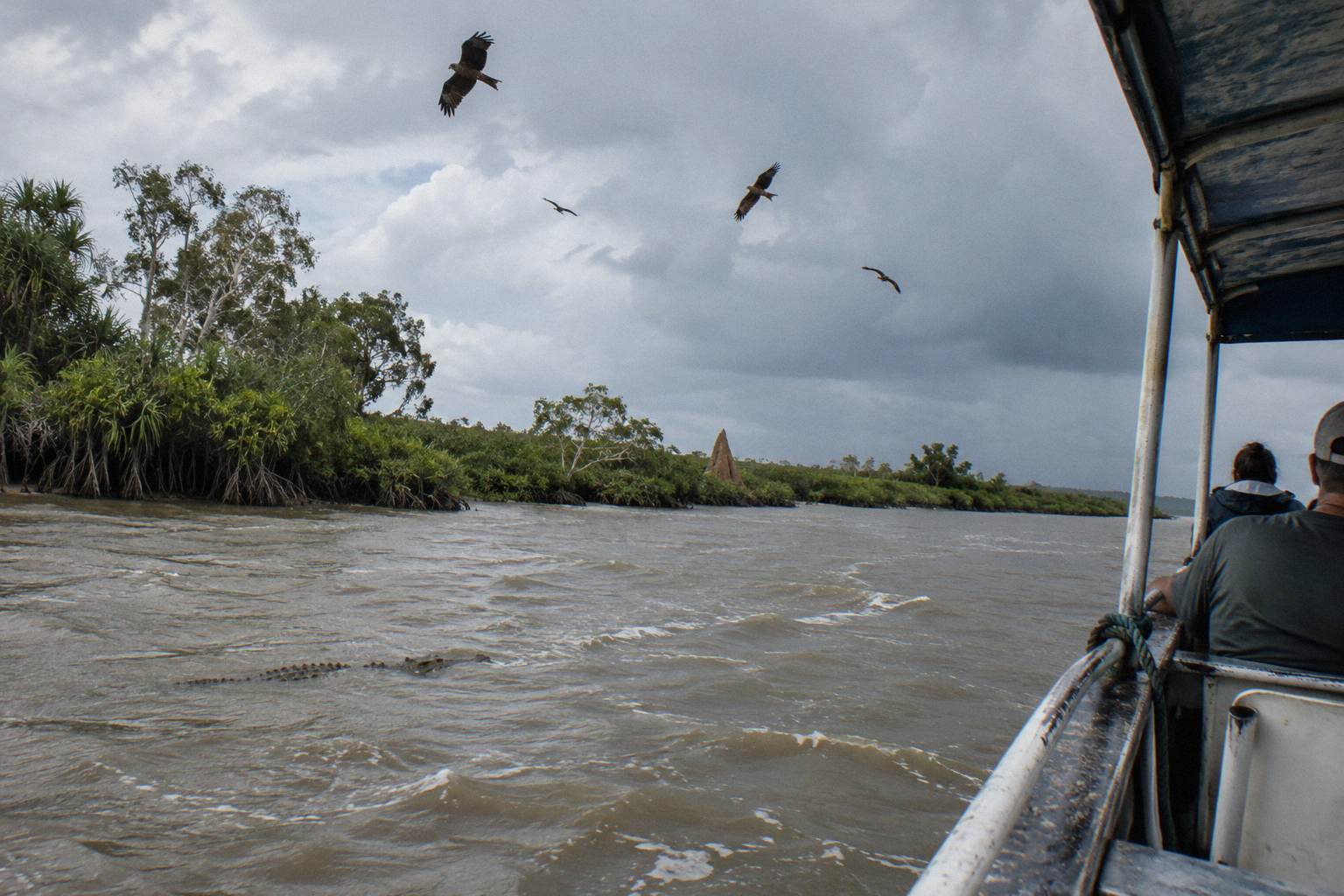
It is worth being clear about the shape of the published record here, because it affects how you read any wildlife claim on the Adelaide River. The only species list that exists is one operator's, on its own what-to-expect page, and it is a plain list with no numbers attached. The other two cruise operators publish nothing comparable. There is no government bird survey of the river in the sources this site is allowed to use, no eBird-style count, and no operator statement about which month is best. If a wildlife sighting matters to your day, the honest framing is that the river is habitat, the birds of prey are resident enough for an operator to name them, and the rest is down to the day.
Photographically, the two raptors are the reason the zoom-lens advice exists. The Adelaide River Cruises FAQ suggests a camera or a charged phone and says a zoom lens is useful for wildlife across the floodplain, while standard phone cameras suit the crocodile interactions because of the proximity, in the operator's own wording. An eagle quartering the far side of the floodplain is a long lens subject; a crocodile rising beside the boat is not. Visitors deciding between a big camera and a phone can read more in the site's guide to photographing jumping crocodiles, which covers the same trade-off in more depth.
| Wildlife | Where it is stated | Notes in the source |
|---|---|---|
| White-bellied sea eagle | Spectacular's species list | Named only; no counts or seasons stated |
| Whistling kites | Spectacular's species list | Named only; no counts or seasons stated |
| Wading birds | Spectacular's access-road note | "Often shows" water buffalo, cattle and wading birds |
| Black flying-fox | Spectacular's species list | Named only |
| Freshwater crocodiles | Spectacular's species list | One of the NT's two crocodile species |
What Sharks And Sawfish Live In The Adelaide River?
The operator's list names three unexpected water-dwellers: bull sharks, the endangered speartooth shark and the critically endangered largetooth sawfish. Those status labels are the operator's wording. Neither the operators nor the NT Government pages used here describe numbers, sizes or how often any of them are seen from a cruise.
This is the part of the list that most visitors find hardest to believe until they stand on the deck and remember the river is not a closed system. Bull sharks are famous for tolerating fresh water, and Top End river systems are exactly their kind of place. The speartooth shark and the largetooth sawfish are the conservation heavyweights. A sawfish is a ray with a long, toothed rostrum, and the largetooth sawfish carries a critically endangered label on the operator's list; the speartooth shark is listed as endangered. Neither is an animal you expect to share a river with a theme-park-style crocodile feed, and yet that is the published claim.
The honest caveat is the same one that runs through this whole page. The species list is one operator's, and it comes without numbers, frequency claims or seasonal notes. Nobody states that passengers see sawfish, nobody states that they don't, and no source gives a population figure for these species in the Adelaide River specifically. For the saltwater crocodile, by contrast, the NT Government does publish population-level facts, roughly 100,000 in the NT wild in 2017 and more saltwater crocodiles in the NT than in Queensland and Western Australia, but it publishes no river-by-river count, including for the Adelaide River. The sharks and sawfish get even less than that: a name and a status label, full stop.
Still, a list like that changes how you look at the water. A surface swirl stops being automatically a crocodile. The black flying-fox on the same list, a large bat that roosts in enormous camps across the Top End, adds an evening dimension for anyone driving out for a late departure. If the wider species cast is part of the appeal, the featured cruise on this page is a good vehicle for it, and availability moves fastest in the peak months: Check availability.
What Animals Appear On The Drive To The Jetty?
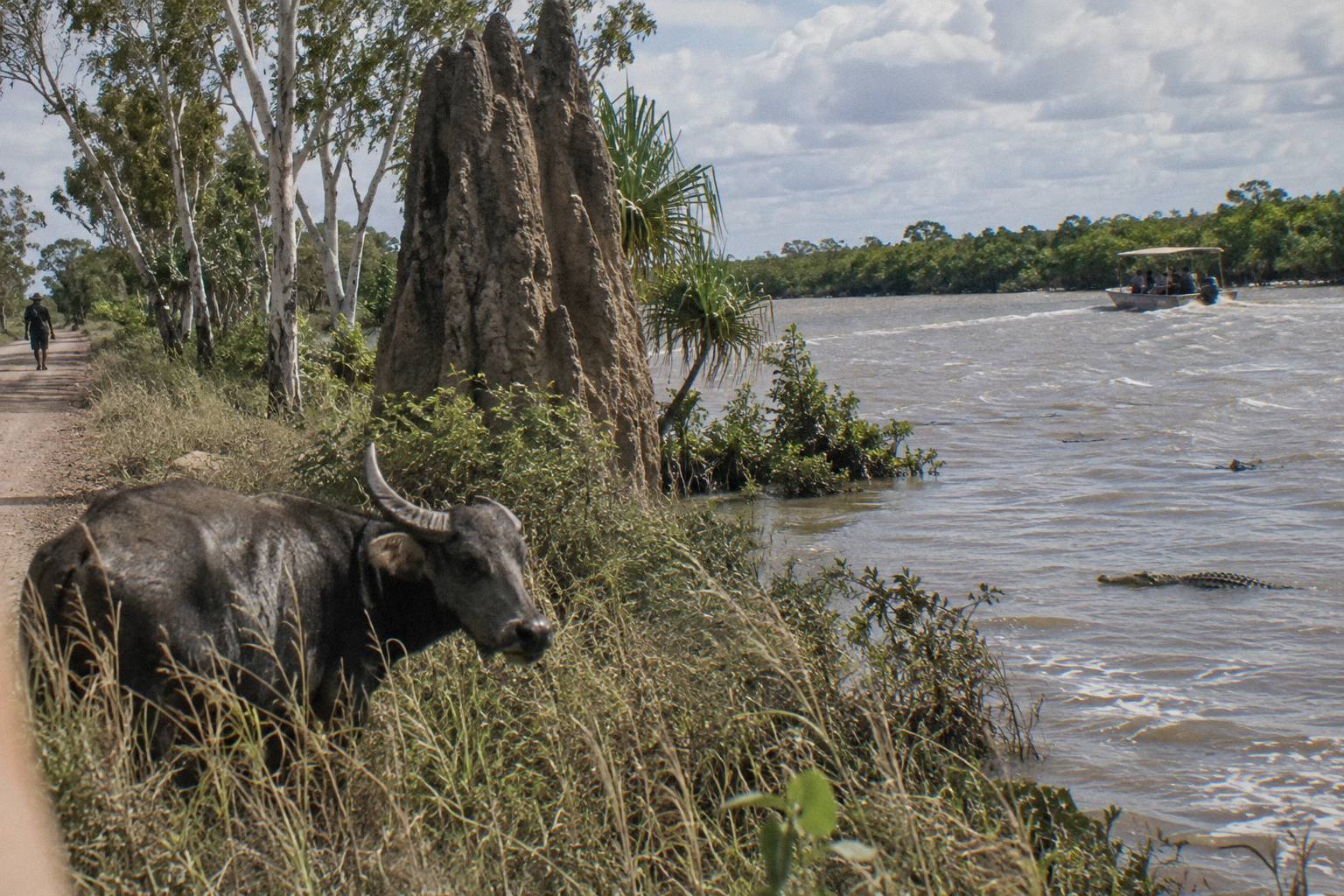
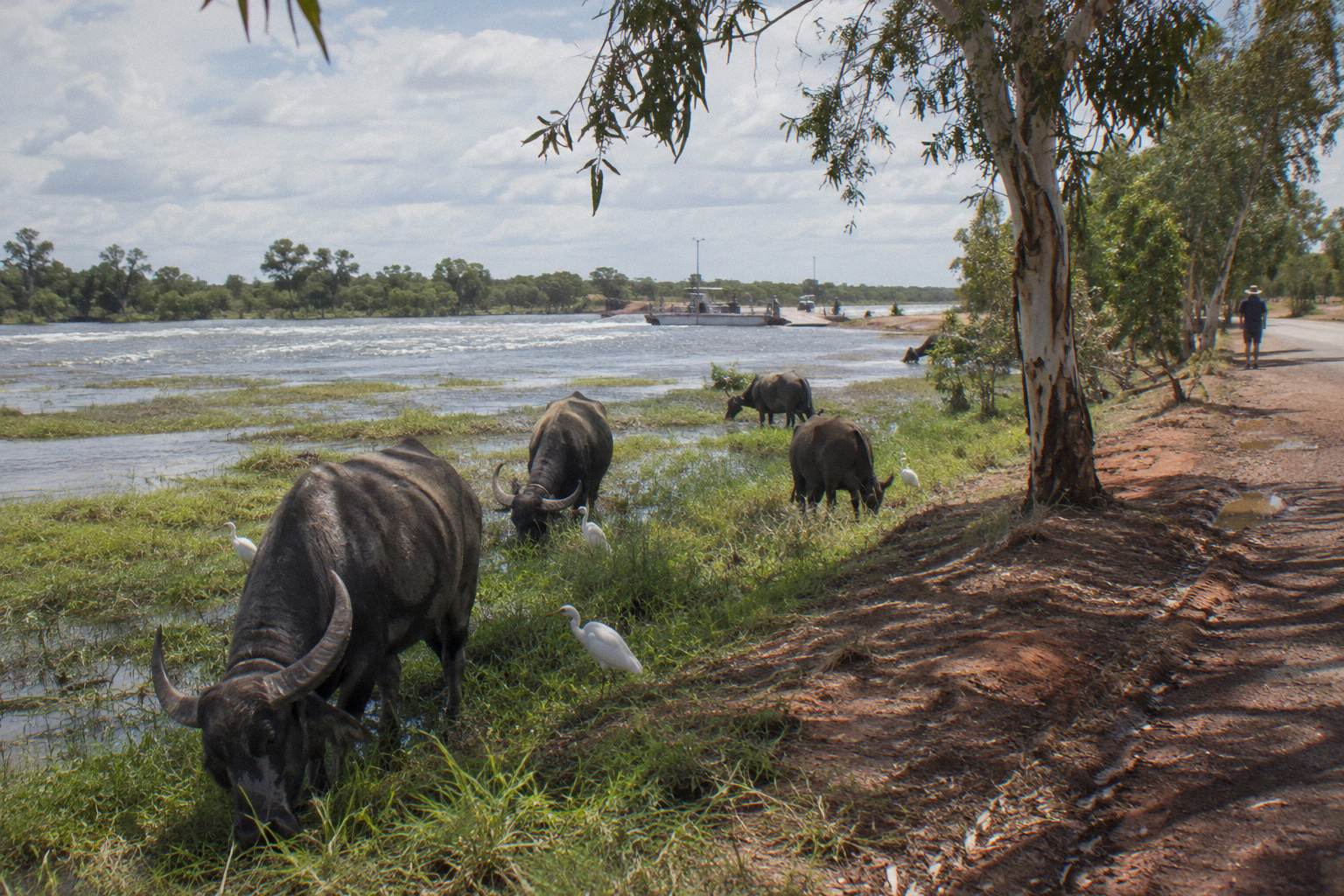
Spectacular says its roughly 2 km unsealed access road often shows water buffalo, cattle and wading birds. That is the entire published claim about the drive. No other operator publishes road wildlife, and no source gives counts, odds or best times for any of it.
Do not skip the approach road as scenery. The jetty used by Spectacular sits on Beatrice Hill Farm at Middle Point, reached via the Windows on the Wetlands Visitor Centre and about 2 km of well-maintained unsealed road that the operator says hire cars handle fine. Water buffalo are a genuinely strange sight for most visitors, introduced animals though they are, standing knee-deep on a floodplain like something from a different continent. Cattle graze the same country. The wading birds work the shallows, and the operator's own getting-here page frames the road as part of the experience rather than a corridor to endure.
The other two operators' approaches are different in character even where the wildlife notes are silent. The Adelaide River Queen and Pathfinder boats leave from the Arnhem Highway at the Adelaide River Bridge, where a giant crocodile statue stands in the car park, on a sealed road the whole way. Adelaide River Cruises departs from Anzac Parade at Middle Point. None of those operators publishes a road-wildlife note, so the buffalo-and-wading-birds claim belongs to one road and one operator only, and it should not be generalised to the others.
Timing plays a practical role here regardless of wildlife. Spectacular asks passengers to arrive at least 15 minutes before departure, and the Adelaide River Queen and Pathfinder ask for at least 30, with late arrivals possibly forfeiting tickets. Building in a few extra minutes for the access road is not just about the buffalo; it is the difference between a relaxed arrival and a sprint down a dirt road. The site's guide to where the cruise boats depart along the Arnhem Highway covers all three locations and arrival windows in detail.
Do The Day Tours From Darwin Add More Wildlife Stops?
Several day tours pair the cruise with wetland stops: Fogg Dam appears on many, and Windows on the Wetlands on others. Those stops are listed as inclusions only. The tour data states no species lists, opening hours or fees for any of these places, and no wildlife sighting is promised anywhere.
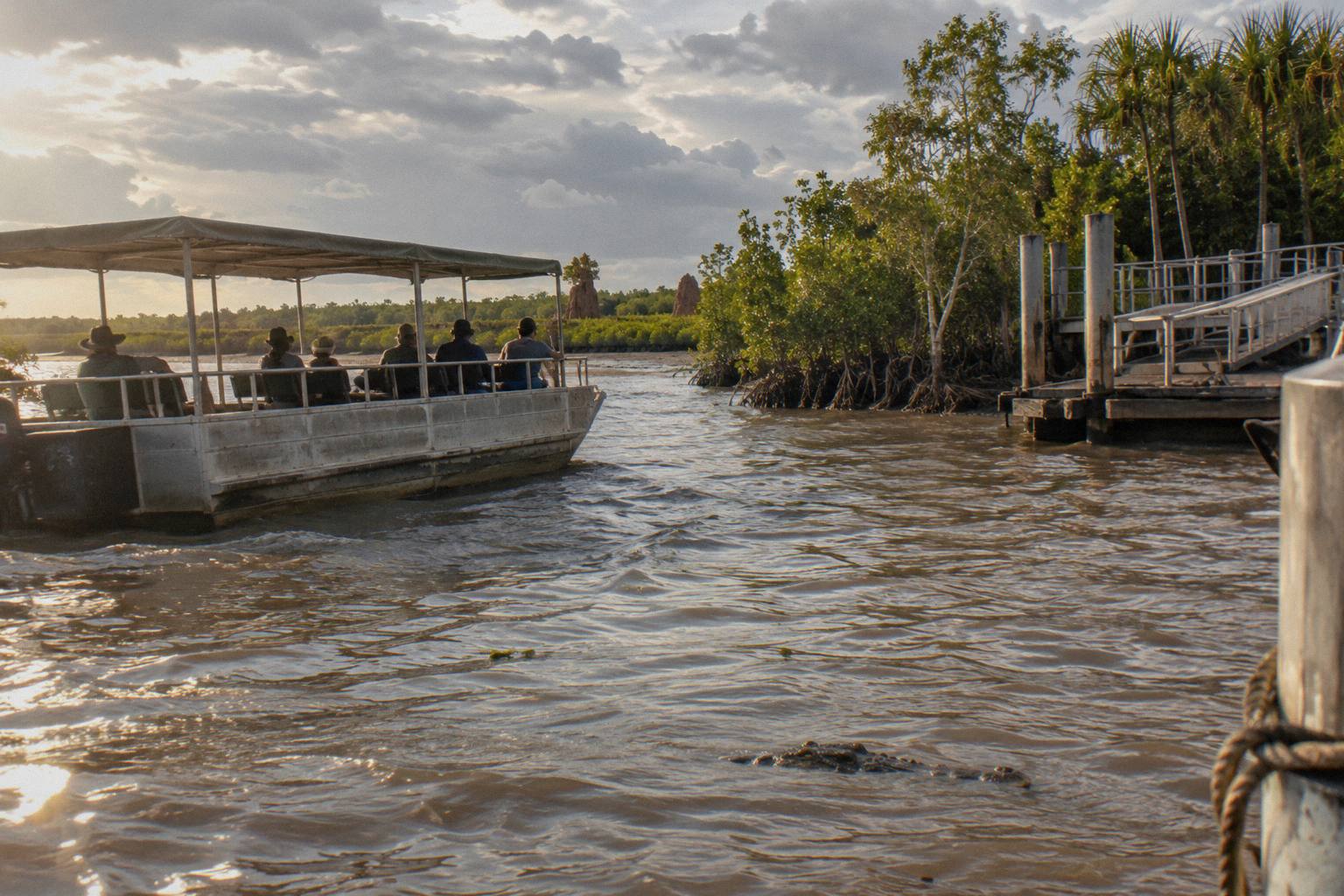
For a visitor whose real interest is the floodplain ecosystem rather than the crocodile moment alone, the day tours are the broader canvas. The pattern in the inclusions is consistent: the short Darwin day tours bundle the one-hour cruise with Fogg Dam, with a Humpty Doo Pub stop, or with Windows on the Wetlands, while the longest one, the Litchfield tour, adds a full national park. Fogg Dam in particular is a name that recurs across the roster, appearing on the Croc Bus, the Wallaroo lunch tour, the Croc Country Safaris tour, the AAT Kings coach tour and the barramundi-fishing combination, which tells you the tour companies treat it as the standard wetland complement to the river.
What this site can honestly say about those stops is deliberately thin. The sources carry no opening hours, distances, entry fees or wildlife descriptions for Fogg Dam or any of the other stopovers; they appear only as inclusions of the named tours. The scope of this page is the Adelaide River itself, so the decision content is simply this: if the non-crocodile wildlife is a big part of why you are coming, a tour that stacks Fogg Dam onto the cruise gives you more habitats in one day than the cruise alone, at the cost of four to six hours instead of one. The cruise operator each day tour uses is stated only for the Croc Bus, which runs with Adelaide River Cruises; for the others, the data does not say.
| Day tour | Duration | Wildlife-relevant inclusions |
|---|---|---|
| The Croc Bus From Darwin | About 4 to 5 hours | Cruise with Adelaide River Cruises, Fogg Dam entry, Humpty Doo stop |
| Jumping Crocodile Adventure Cruise With Lunch | About 4 hours | Cruise, Fogg Dam, Window on the Wetlands, Humpty Doo Pub lunch |
| Jumping Crocodile Cruise And Fogg Dam | About 5 hours | Cruise, Fogg Dam, Hooked on Barra entry |
No price, start time or rating is stated for any day tour on this site; the live listing for each carries those, and the earlier advice about reading the booking page's own terms applies to all of them. For visitors weighing the full-day Litchfield version against the shorter wetland runs, the site's comparison of Litchfield and the jumping crocodile cruise covers the trade-offs.
How Should You Watch And Photograph The River Wildlife?
Bring water, sunscreen, a hat and a camera, comfortable clothing and sturdy footwear, per Spectacular's published kit list; the operator encourages photography and runs tours in English. Adelaide River Cruises says a zoom lens suits floodplain wildlife while phone cameras suit the close crocodile work. No operator publishes wildlife photography odds or best seats.
The gear advice splits cleanly along the same line as the wildlife itself. The crocodile interactions happen at close range, which is why one operator can say, in its own words, that standard phone cameras suit them because of the proximity. Everything else on the river, the eagles, the kites, the wading birds, whatever moves across the open floodplain, sits at a distance, and that is what the zoom lens comment is for. A visitor with only a phone should not feel short-changed by the crocodiles; a visitor with a long lens should point it at the sky and the far water between feeds.
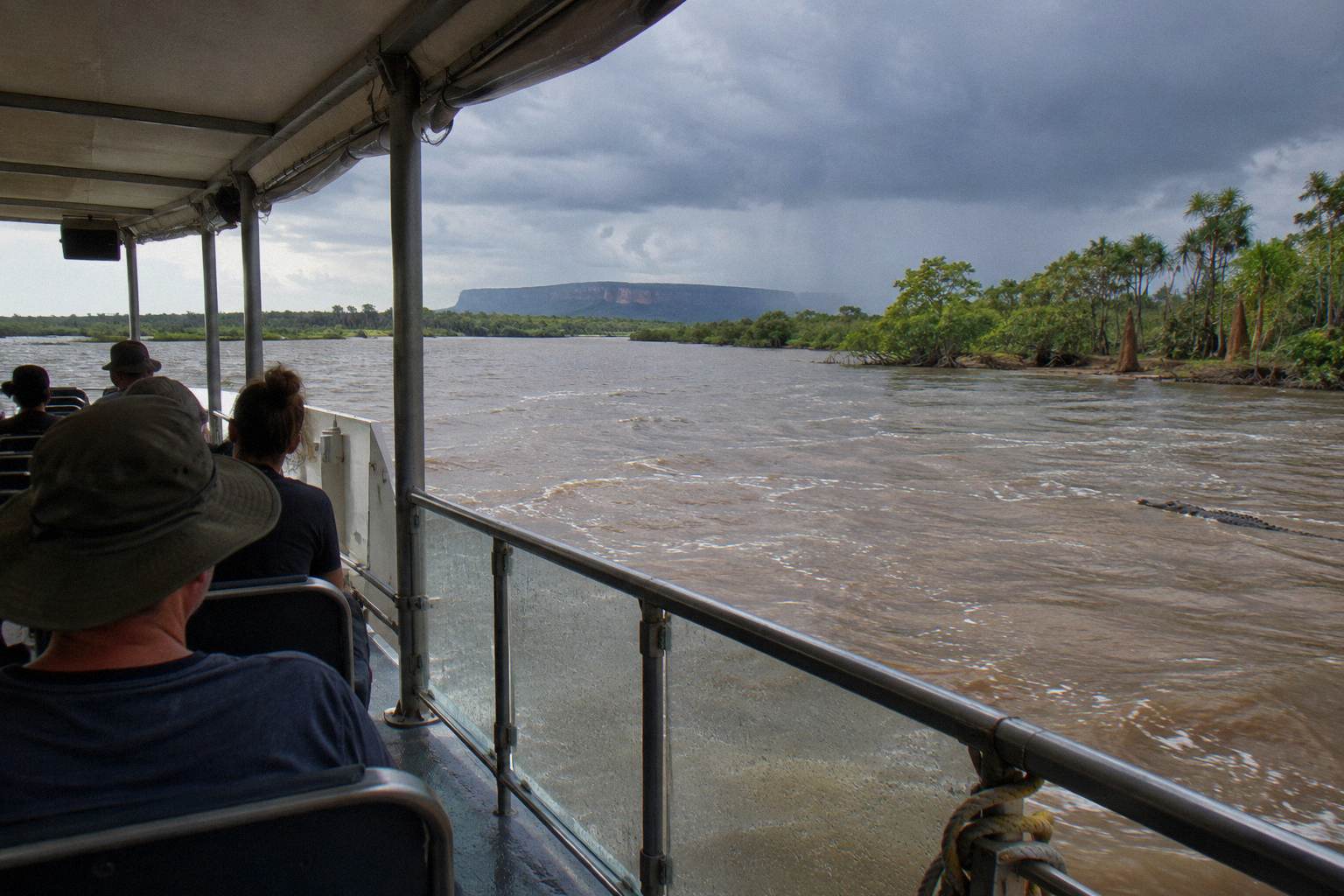
There is no best side of the boat, and it matters that this page says so plainly, because it is a question people ask. No operator and no NT Government page publishes a jump height, a jump distance, a how-close-to-the-boat figure or a seat advantage, so any confident claim about where to sit for wildlife is invention. The vessels themselves differ in character, which is the honest version of the question: Spectacular's Croc-Cat1 has stadium-style seating with the skipper at the rear and its Wildcat is smaller and goes further down the river, while the Adelaide River Queen offers an air-conditioned lower deck and an open-air shaded upper deck, and the Pathfinders are open-air vessels of up to 38 passengers. Which of those suits your watching style is a real decision; a seat number is not.
Behaviour on board matters more than seating. The Original/Queen operator's rules include no swimming, no food on the boat, life jackets on board and supervised children, and the NT Government's Be Crocwise advice includes not leaning out of or dangling limbs over the side of a boat. The NT Government also states that any body of water in the Top End may contain large and potentially dangerous crocodiles. Watching wildlife responsibly on this river means watching it from inside the vessel, full stop.
What Do The Saltwater And Freshwater Crocodiles Have To Do With The Wildlife List?
The NT has two crocodile species: the saltwater crocodile, Crocodylus porosus, which the jumping cruises feed, and the freshwater crocodile, Crocodylus johnstoni, which appears on Spectacular's wildlife list as a separate sighting. Both are protected by law, and neither can be taken or interfered with without a permit.
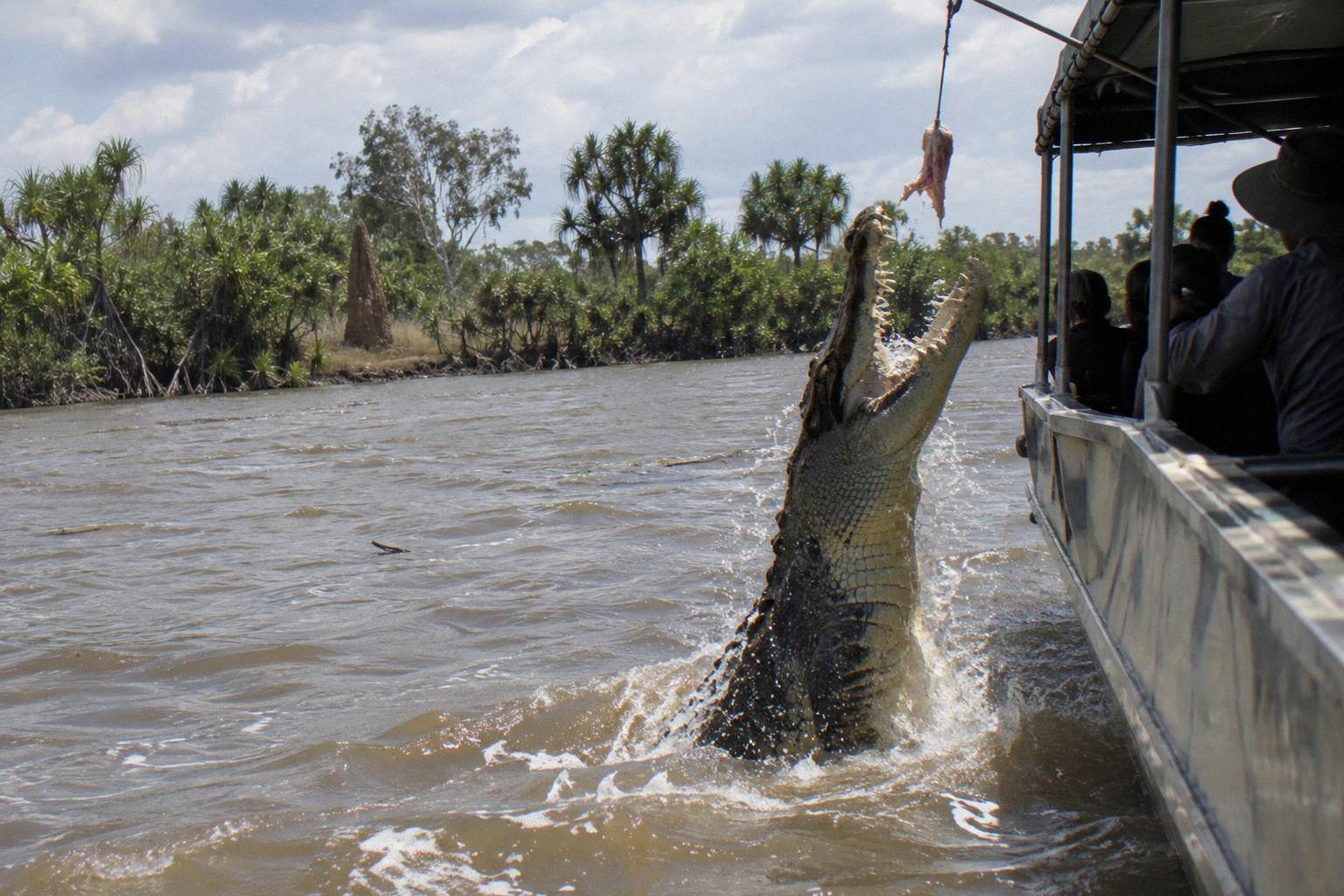
This distinction is the quiet information gain in the wildlife question, and it comes straight from the NT Government rather than any operator. The crocodiles that leap for buffalo meat are saltwater crocodiles, the largest living reptile, the species that can stay underwater up to an hour with a heart rate of 2 to 3 beats a minute and move faster than humans on land in short bursts. The freshwater crocodile on the operator's list is the other species entirely, smaller, fish-eating, and a different animal to spot. A passenger who sees a crocodile on the cruise and assumes it is "the" crocodile may be looking at either, and no operator publishes a way to tell them apart from the boat, so treat any crocodile as the dangerous saltwater kind and let the guide say otherwise.
The protection status is the NT Government's line and it frames the whole feeding question too. Both species are protected, you cannot take or interfere with a crocodile without a permit, and the saltwater crocodile went from almost extinct in the 1970s to widespread and no longer considered threatened. Roughly 100,000 saltwater crocodiles lived in the NT wild in 2017, thought to be at or approaching pre-hunting levels. The operators' feeding claims sit inside that permit system: Spectacular says its staff hold Wildlife Permits from NT Parks and Wildlife, keep detailed feeding logs and developed an Animal Ethics Policy with Parks and Wildlife, while the Original/Queen operator says its crocodiles are 100% wild and feeding is done under NT wildlife permits. Nobody in the sources goes further than that, and neither will this page.
Which Cruise Setting Suits A Wildlife Watcher?
Open-air boats and shaded decks are the real choice: the Pathfinders are open-air vessels of up to 38 passengers, the Adelaide River Queen has an air-conditioned lower deck and a shaded open-air upper deck, and Spectacular's two vessels are undercover. The sources state no wildlife difference between any of them.
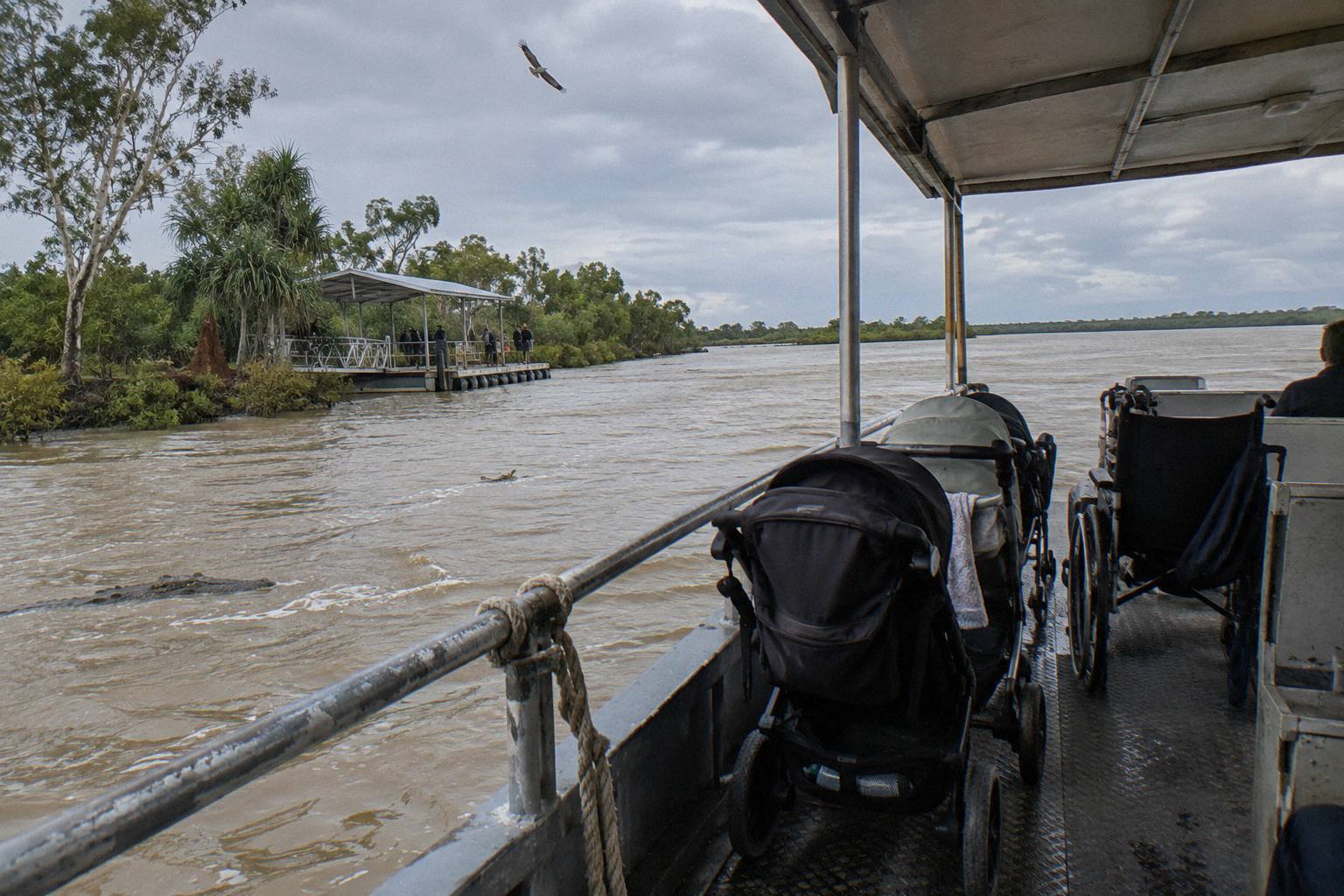
That last sentence is the part to hold onto. It would be easy to assume an open boat gets you closer to the birds, or that an undercover vessel costs you photographs, and neither claim exists in anything the operators or the NT Government publish. What is published is boat character, and it is worth deciding on comfort grounds. The Pathfinder cruise is the roster's open-air, flat-fare option at A$75 for any passenger aged 1 and over, with a current operator promotion letting one child under 13 travel free per full-paying passenger for travel between 5 October 2026 and 31 March 2027 unless it ends earlier, on limited seats, so check that the promotion applies when you book. The Adelaide River Queen runs the 1pm departure with its two-deck layout. Spectacular's Croc-Cat1 and Wildcat are both undercover, with the smaller Wildcat going further down the river.
For wildlife watchers, the practical read is that all three settings put you on the same river with the same published species list problem: only one operator lists species, and the list is not tied to a particular vessel. A wildlife enthusiast's genuine decisions are the departure time that fits the day, the boat that suits the weather, and the camera that suits the distances, which is why this site keeps those decisions, not imaginary sighting guarantees, at the centre of its cruise comparisons. If you are still weighing whether the whole experience earns its ticket price, the blog's own take on whether a jumping crocodile cruise is worth it works through that question with the same restraint.
The longer wildlife day has its own pull, and it is the berry-springs run that stretches furthest:
Common Questions About Adelaide River Wildlife
What Wildlife Can You See On The Adelaide River Besides Crocodiles?
Spectacular Jumping Crocodile Cruises, the only operator to publish a list, names white-bellied sea eagles, whistling kites, freshwater crocodiles, bull sharks, black flying-fox, the endangered speartooth shark and the critically endangered largetooth sawfish, and says its access road often shows water buffalo, cattle and wading birds. No sighting is promised by any operator.
Are There Saltwater Crocodiles In The Adelaide River?
Yes. The jumping-cruise crocodiles are saltwater crocodiles, Crocodylus porosus, the NT's larger of two crocodile species. No published source gives a river-by-river population count for the Adelaide River specifically.
Can You See Sharks In The Adelaide River?
The operator's list names bull sharks, the endangered speartooth shark and the critically endangered largetooth sawfish as river wildlife, in the operator's wording. No source states how often any of them are seen from a cruise, and no sighting odds exist.
What Animals Do You See On The Drive To The Cruise?
Spectacular says its roughly 2 km unsealed access road at Middle Point often shows water buffalo, cattle and wading birds. That is the only published road-wildlife note among the three operators.
Which Side Of The Boat Is Best For Wildlife?
No operator or NT Government page publishes a seat advantage, a jump height or a how-close figure. Choose a boat for its deck layout and cover, not for an imaginary best side.
Do The Day Tours Visit Other Wildlife Spots?
Several include Fogg Dam, Windows on the Wetlands or Humpty Doo stops alongside the cruise. The tour data states no species lists, hours or fees for those stops, and the site this post belongs to, Adelaide River Crocodile Cruise, covers them only as inclusions.